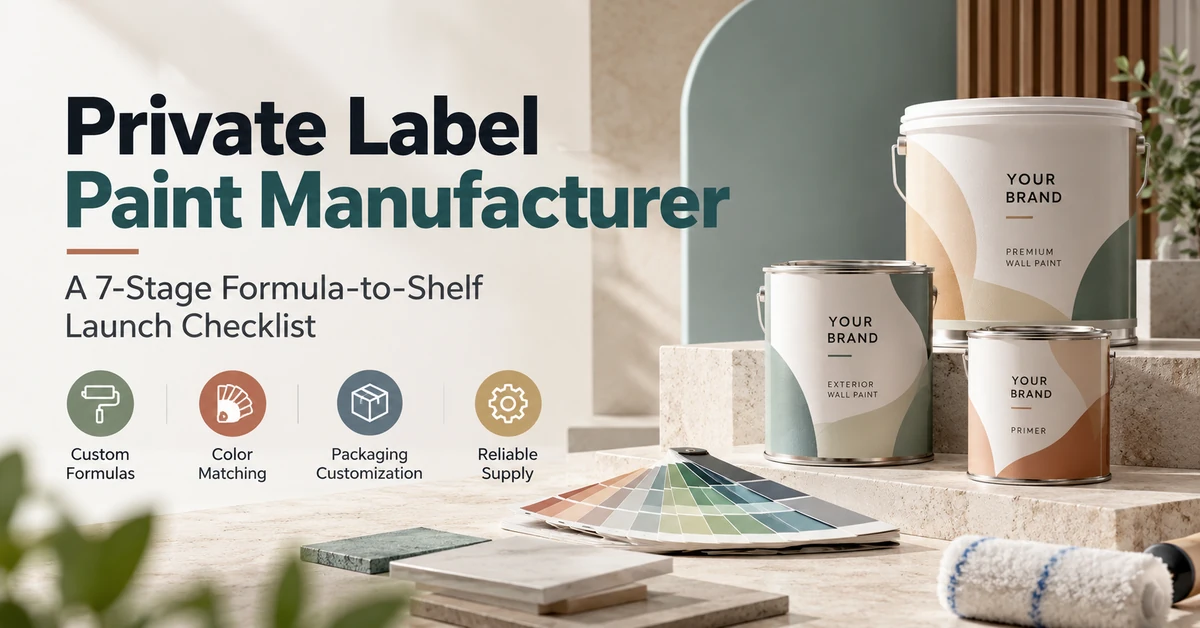
Finding the right private label paint manufacturer is one of the most important decisions for distributors, building-material importers, and companies preparing to launch their own paint brands. A successful private label program requires more than applying a new logo to an existing container. Product performance, color consistency, packaging, regulatory documentation, production planning, and long-term supply must all work together.
The most reliable approach is to develop your product line through seven controlled stages: market positioning, product selection, formulation review, sample validation, packaging approval, commercial confirmation, and repeat-supply planning.
Whether your business targets residential decoration, commercial construction, waterproofing, or industrial maintenance, these steps help reduce avoidable launch risks.
This guide explains how to turn a coating concept into a commercially viable private label product range, what technical information to request, and how VERDA's OEM and Private Label Coatings Program can support qualified brand development projects.
1. What Does a Private Label Paint Manufacturer Do?
A private label paint manufacturer supports businesses that want to sell paint or coatings under their own brand instead of developing every formulation and production process independently.
Depending on the arrangement, services may include selecting existing coating products, discussing formulation adjustments, matching colors, preparing branded packaging, coordinating samples, and planning commercial production.
However, three cooperation models should be distinguished.
| Manufacturing model | Main characteristics | Suitable buyers |
|---|---|---|
| Standard private label | An existing or approved coating product supplied with agreed branded packaging | New paint brands, wholesalers, regional distributors |
| Customized OEM coatings | An existing product direction adapted to defined performance, color, or market requirements | Established brands targeting differentiated products |
| New formulation development | A more extensive development project requiring technical feasibility assessment, testing, and commercial approval | Brands with specialized performance requirements |
Standard private labeling may involve fewer development steps because the underlying formulation already exists. Customized formulations may require additional sampling, validation, production planning, and investment.
Private label is not automatically the same as an exclusive formulation. Ownership, confidentiality, exclusivity, and permitted brand use should be agreed in writing.
Who should consider private label manufacturing?
This model is particularly relevant to paint distributors expanding into proprietary products, retailers creating house brands, building-material importers entering new markets, and established coating companies extending their product portfolios.
It may be unsuitable for businesses without a defined sales channel, realistic purchase forecast, or ability to manage local product compliance.
2. The 7-Stage Private Label Paint Development Process
An organized development process reduces uncertainty before commercial production begins.
Stage 1: Define Your Market and Product Positioning
Start by defining who will buy your paint and why they should choose it.
An economy interior wall paint intended for residential renovations has different requirements from a premium washable coating for hotels or a protective system for industrial steel.
Your initial product brief should identify:
-
Target country and distribution channel.
-
Customer segment and expected application.
-
Required product category and finish.
-
Target retail or wholesale price positioning.
-
Performance expectations and applicable standards.
-
Preferred packaging and estimated purchasing volume.
A distributor serving tropical regions, for example, may prioritize exterior weather resistance, moisture-related performance, and appropriate mildew protection.
A commercial contractor may prioritize coverage, substrate compatibility, drying conditions, and consistency across project phases.
The manufacturer needs this information before recommending a formulation.
Stage 2: Select the Right Coating Category and Formula Direction
Avoid developing an extensive product range before identifying the categories with realistic demand.
Start with one or two closely related product families and expand after the initial range has been validated.
VERDA's professional coating portfolio covers architectural paints, waterproofing coatings, floor and traffic coatings, and industrial protective coatings.
| Private label product category | Target market | Important performance considerations |
|---|---|---|
| Interior wall paint | Paint stores, residential contractors, developers | Hiding power, finish, wash resistance, application behavior |
| Exterior wall paint | Building-material distributors, facade contractors | Weather resistance, color retention, adhesion, moisture exposure |
| Wall primers | Construction supply chains, renovation contractors | Substrate sealing, alkali resistance, compatibility |
| Waterproof coatings | Waterproofing specialists, construction suppliers | Crack movement, water exposure, system compatibility |
| Epoxy floor coatings | Industrial flooring contractors | Abrasion, chemical exposure, curing, substrate moisture |
| Industrial protective coatings | Metal fabricators, project suppliers | Corrosion environment, coating compatibility, dry film thickness |
For an architectural brand, a practical starting range might include an interior primer, interior topcoat, and exterior paint.
For industrial customers, product selection should focus on complete compatible coating systems rather than individual coatings in isolation.
Learn more about VERDA's residential and commercial building solutions and industrial metal protection systems.
Stage 3: Establish Technical Specifications Before Customization
A professional private label paint manufacturer should help define measurable product requirements.
Paint performance is influenced by resin chemistry, pigment and filler selection, additives, application conditions, and compatibility with the substrate.
Common formulation components include acrylic or other polymer binders, pigments, mineral fillers, dispersants, rheology modifiers, and preservatives where applicable.
Their selection depends on the intended product. Exact compositions and manufacturing processes require supplier confirmation.
Before sample development, create a technical specification covering relevant requirements.
| Technical parameter | Why it matters |
|---|---|
| Binder or resin type | Influences performance characteristics and application compatibility |
| Viscosity | Affects brushing, rolling, spraying, and leveling |
| Density | Supports packaging, logistics, and quantity calculations |
| Volume solids | Helps determine coating build and theoretical consumption |
| Hiding power | Important for decorative paint coverage |
| Wet-scrub resistance | Relevant to selected washable interior wall coatings |
| Drying and recoating | Influences project scheduling and application procedures |
| Gloss and color | Determines decorative appearance and finish expectations |
| Adhesion | Influences substrate compatibility and coating performance |
| Storage stability | Important for distribution, warehousing, and shelf life |
For interior architectural coatings, ISO 11998:2026 provides a method for determining wet-scrub resistance under specified test conditions.
For corrosion-protection projects, ISO 12944-2:2017 describes environmental corrosivity classifications relevant to selecting protective coating systems.
These standards are technical references, not automatic evidence that a particular paint has passed testing or obtained certification.
A product should only carry performance claims that are supported by appropriate evidence.
Stage 4: Approve Samples, Colors, and Quality Requirements
Sample approval should take place before committing to a large private label order.
For architectural coatings, buyers should evaluate application behavior, finish, color, coverage, drying, and relevant resistance characteristics.
For industrial products, evaluation may additionally involve adhesion, film thickness, chemical exposure, and coating-system compatibility.
A practical sample-approval process should establish:
-
The exact product or formulation version.
-
The substrate and test conditions.
-
The approved physical color reference.
-
The performance criteria and available test results.
-
The sample identification and approval record.
Color control deserves particular attention because visual inconsistency can affect the reputation of a new paint brand.
VERDA provides color matching services, including reference matching, project color coordination, and physical sample confirmation.
For repeat orders, brand owners should agree on how approved colors, formulation versions, and batch identification will be recorded.
A visually acceptable sample is only the beginning. Repeat-order quality depends on documented specifications and appropriate production controls.
Stage 5: Design Packaging, Labels, and Market Documentation
Packaging is both a branding tool and a functional part of paint distribution.
Container compatibility, sealing, handling, storage, palletization, labeling, and visual presentation should be considered together.
A private label packaging brief should address container size, material, closure type, branding placement, product naming, color identification, language requirements, and logistics.
Typical label information may include product identification, net contents, application directions, batch identification, storage guidance, and required hazard information.
However, labeling requirements differ by country, product classification, and intended use.
For example, the United States has architectural-coating VOC requirements administered by the Environmental Protection Agency, while applicable hazard-communication and SDS obligations must also be addressed. Other destinations may impose different chemical, labeling, or product-registration requirements.
Terms such as "eco-friendly," "non-toxic," "zero VOC," or "antibacterial" should not be used without adequate substantiation and the required local compliance review.
VERDA's OEM program includes packaging-direction and label-review discussions, but local market approval responsibilities must be defined for each project.
Stage 6: Confirm MOQ, Production Costs, and Commercial Terms
Private label manufacturing costs depend on more than the coating itself.
The formulation, packaging format, number of colors, artwork preparation, testing, initial order volume, and transportation terms can all influence the commercial arrangement.
Before approving your first production order, request a detailed quotation.
| Cost element | Questions to ask |
|---|---|
| Coating formula | Is the quotation based on an existing or adjusted formulation? |
| Sample development | Are sampling and testing charges applicable? |
| Packaging | Are custom pails, labels, or printing subject to minimum quantities? |
| Order quantity | Does MOQ apply per formula, color, packaging size, or combined order? |
| Documentation | Which TDS, SDS, testing, and export documents are included? |
| Freight | Which trade terms and destination are used for the quotation? |
| Repeat orders | Can specifications and packaging be maintained consistently? |
Avoid assuming that every OEM manufacturer offers the same minimum order quantity.
VERDA confirms that MOQ, price, and lead time depend on the product, packaging, formulation direction, and agreed order plan.
A commercially attractive quotation should therefore be evaluated against total delivered cost, not only the factory price per litre.
Stage 7: Approve the First Order and Plan Repeat Supply
Once samples, specifications, packaging, and commercial conditions have been approved, the project can move toward production coordination.
For long-term brand development, maintain a controlled product specification file containing the approved formula or product identifier, color reference, packaging artwork revision, technical documents, and relevant inspection criteria.
Agree on how future changes will be communicated.
A formula adjustment, raw material substitution, or packaging change may require additional review even when the product name remains unchanged.
The objective is to create a repeatable manufacturing arrangement that supports your brand beyond its initial launch.
3. Which Paint Products Can Form the Foundation of Your Brand?
A new paint brand should offer a clear product hierarchy rather than an unrelated collection of coatings.
For example, architectural distributors can organize their range around surface preparation, standard finishes, and selected differentiated products.
The following VERDA products illustrate different positioning opportunities.
| Reference model | Product positioning | Key published characteristics | Potential role in a product range |
|---|---|---|---|
| WEW-01 | Weather-resistant exterior wall paint | Water-based, satin finish, outdoor protection | General exterior wall coating |
| SJW-200 | Self-cleaning exterior wall paint | Water-based, semi-gloss, reduced surface dirt accumulation | Differentiated exterior coating |
| NAB-130 | Interior wall sealing primer | Water-based, substrate sealing, adhesion support | Surface preparation product |
These are VERDA reference products, not confirmation that every formula is automatically available for private labeling. Final OEM eligibility and customization options require project review.
Buyers can examine WEW-01 exterior paint, SJW-200 self-cleaning exterior paint, and NAB-130 interior wall primer as examples of distinct product roles.
For brands targeting professional contractors, pairing primers and finishing coats may be more valuable than offering multiple products with overlapping functions.
For industrial markets, the product range should be developed around defined application environments and compatible systems.
4. How Should You Evaluate Manufacturing and Quality-Control Capabilities?
An attractive label does not compensate for inconsistent product performance.
When assessing an OEM paint manufacturer, buyers should understand how formulation requirements move through production, inspection, and shipment approval.
A typical coating manufacturing workflow may include raw material verification, controlled weighing, dispersion or mixing, adjustment, in-process testing, filling, and final inspection. The exact workflow varies by formulation and equipment.
Request information relevant to your product rather than assuming that every factory follows an identical process.
Key evaluation areas include:
-
Incoming raw material identification.
-
Formulation and batch-control procedures.
-
Mixing or dispersion consistency.
-
Relevant viscosity, density, color, or performance checks.
-
Packaging and label inspection.
-
Batch traceability and complaint-handling procedures.
-
Availability of relevant testing and supporting documents.
Ask whether inspection reports can be provided for the product and order under discussion.
VERDA describes its commitment to product consistency, formulation alignment, packaging coordination, and technical communication through its Quality Commitment page.
This provides a basis for discussion, while any specific testing, certificates, or acceptance criteria should be confirmed before purchase.
5. How to Avoid the Most Common Private Label Paint Launch Risks
Several problems repeatedly affect new coating brands.
Launching too many products: A broad initial range can increase stock requirements and complicate quality management. Begin with a focused assortment that matches your sales channels.
Choosing formulas based only on price: Lower-cost products may not satisfy the coverage, durability, application, or performance expectations of your target customers.
Skipping sample approval: Unverified color, finish, or application behavior can create expensive disputes after delivery.
Using unsupported performance claims: Labels promising special environmental, health, or technical benefits need reliable evidence and an appropriate regulatory review.
Ignoring the cost of customization: Multiple colors, container sizes, label versions, and formulation changes can increase purchasing complexity.
Failing to define ownership and confidentiality: Brand assets, formula-related rights, artwork, market exclusivity, and confidentiality should be addressed contractually.
Neglecting repeat-order controls: A successful first batch is not enough if future product versions cannot be identified and consistently supplied.
These issues can be reduced through a written development brief, stage-based approvals, and clear division of responsibility between brand owner and manufacturer.
6. Why Work with VERDA for Private Label Coating Development?
VERDA offers an OEM and private-label cooperation pathway for distributors, importers, paint brands, retailers, and project supply businesses.
Its published support scope includes product category selection, formulation direction discussions, color and sample coordination, packaging and label review, technical document coordination, and commercial order planning.
This is particularly relevant for buyers seeking to develop a coating range across several applications rather than source a single decorative paint.
Through VERDA, qualified partners can discuss architectural coatings, waterproofing systems, flooring products, traffic coatings, and industrial protective coatings according to their market requirements.
Buyers can review the VERDA Product Catalogs and available TDS and SDS resources before preparing a development inquiry.
Every project remains subject to technical feasibility, packaging availability, commercial terms, and the agreed approval process.
Developing your own paint brand? Explore VERDA's Private Label and OEM Manufacturing Program to discuss your product concept and available support.
7. What to Include in Your Private Label Paint Manufacturing Inquiry
A detailed inquiry makes technical evaluation and quotation more efficient.
Before contacting a manufacturer, prepare the following information.
| Inquiry detail | Information to provide |
|---|---|
| Company profile | Business type and existing distribution channels |
| Target market | Country, customer segment, and intended applications |
| Product category | Interior paint, exterior paint, primer, waterproofing, industrial coatings |
| Product positioning | Economy, standard, premium, or specialized |
| Technical targets | Substrate, finish, performance expectations, relevant standards |
| Formula approach | Standard private label or requested customization |
| Color requirements | Reference codes, samples, planned color range |
| Packaging | Container size, branding, label language, artwork direction |
| Purchase forecast | Initial quantity and estimated repeat-order demand |
| Documentation | TDS, SDS, testing, certificates, and import requirements |
| Launch planning | Desired approval process and expected delivery schedule |
Clear information helps the supplier determine which product options can be discussed and which details need further technical or commercial review.
To begin, contact VERDA with your brand concept, target market, required coating category, packaging expectations, and estimated order volume.
8. Frequently Asked Questions About Private Label Paint Manufacturing
1. What is the difference between private label paint and OEM paint?
Private label paint generally involves supplying an existing or selected product under the buyer's brand. OEM arrangements may include more detailed discussions about formulation, performance, color, or packaging. The exact commercial definition depends on the agreement.
2. Can I start a paint brand without owning a factory?
Yes. A qualified manufacturing partner may support product selection, production, packaging, and documentation, allowing the brand owner to focus on distribution and market development. The brand owner must still manage commercial and regulatory responsibilities.
3. What is the minimum order quantity for private label paint?
MOQ varies according to the formula, packaging, color requirements, labeling, and production arrangement. A manufacturer may apply different minimum quantities to standard products and customized projects. Request a quotation based on your intended order.
4. Can a private label paint manufacturer customize the formula?
Formula adjustments may be possible depending on the product category, target performance, technical feasibility, testing requirements, and commercial scale. Custom development should be evaluated before any performance guarantee or delivery commitment is made.
5. Can I use my own logo and packaging design?
Private label programs typically involve discussions about brand placement, label artwork, product naming, and packaging. Exact container options, printing requirements, artwork approval, and intellectual-property responsibilities should be confirmed with the manufacturer.
6. What technical documents should I request?
Request the current TDS and SDS, available test reports, application instructions, and relevant product identification records. Depending on the market, additional compliance or import documentation may be needed. Certificates should be checked for validity and product scope.
7. How do I ensure consistent paint color between batches?
Use approved physical references, defined color identifiers, appropriate tolerances, and a documented sampling process. Record the approved formulation and color version. Batch-to-batch controls should be agreed before repeat production.
8. How long does private label paint production take?
Timing depends on whether an existing product is used or development is required. Sampling, formula review, packaging preparation, artwork confirmation, testing, and production scheduling can affect the timeline. The final lead time should be confirmed for the individual order.
9. Can I develop both architectural and industrial coatings under one brand?
Potentially, yes. However, each category has different technical, safety, application, and documentation requirements. Industrial protective coatings may require more extensive system validation than decorative wall paints. Availability and customization must be reviewed separately.
10. How do I choose the right private label paint manufacturer for long-term cooperation?
Look for relevant product capability, transparent technical communication, clear sample and specification approvals, suitable documentation, quality-control arrangements, workable commercial terms, and repeat-order planning. Evaluate the complete manufacturing relationship rather than choosing solely on the lowest quoted price.
Conclusion
Working with a reliable private label paint manufacturer provides an opportunity to build a differentiated coating brand without independently developing every production resource.
However, successful private label manufacturing requires a disciplined approach to product selection, formulation requirements, samples, technical verification, packaging, compliance, pricing, and repeat supply.
For distributors, importers, and established paint brands, the strongest long-term value comes from products that fit real market needs and can be consistently specified, supplied, and supported.
VERDA provides a practical route for discussing private label architectural and industrial coatings, packaging customization, color matching, technical documentation, and long-term manufacturing cooperation.
Ready to develop or expand your own paint brand? Request a Private Label Paint Manufacturing Quote from VERDA. Share your target market, coating requirements, packaging preferences, and estimated order volume to begin a focused OEM project discussion.