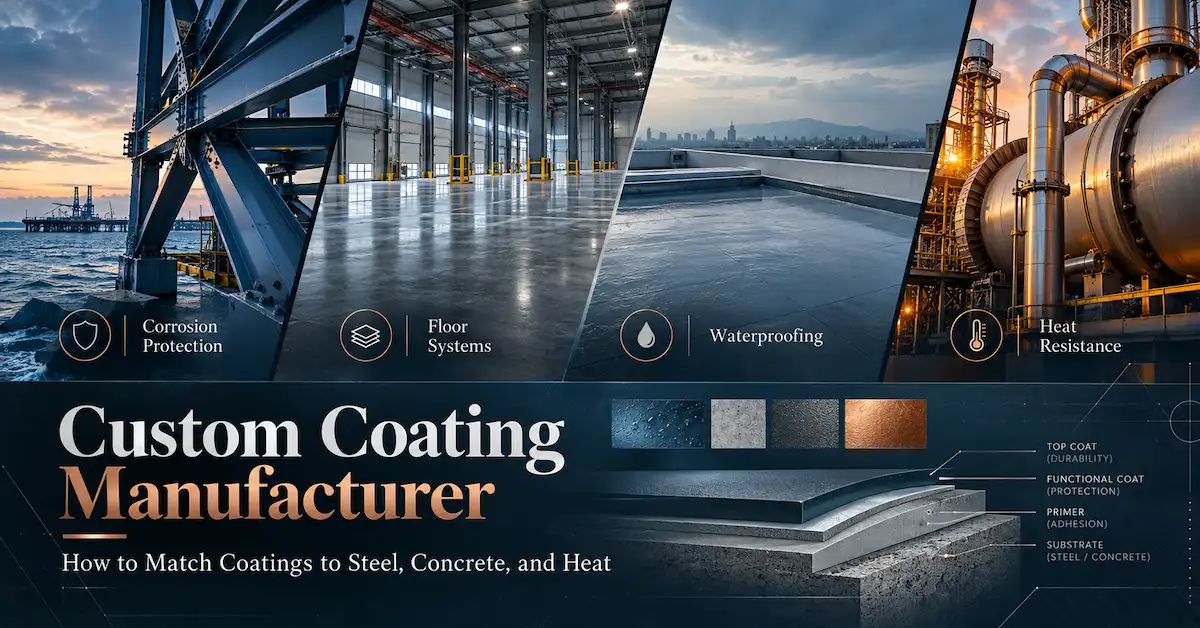
Selecting a custom coating manufacturer is critical when standard paints cannot adequately address a project's substrate, exposure conditions, application constraints, or performance requirements. For industrial equipment manufacturers, engineering contractors, facility operators, and coating distributors, the wrong coating system can lead to corrosion, delamination, moisture-related failure, premature maintenance, and costly operational interruptions.
The best custom coating solution starts with the operating environment—not the paint formula. Buyers should identify the substrate, corrosive exposure, temperature range, mechanical stresses, application method, and expected service conditions before selecting coating materials or requesting formulation adjustments.
A suitable solution may require an epoxy primer and polyurethane topcoat, a specialized concrete floor system, an elastic waterproofing membrane, or a heat-resistant silicone coating. Each addresses a different technical challenge.
This guide explains how to evaluate coating technologies, define technical specifications, compare protective systems, and work with a manufacturer such as VERDA to develop an application-oriented coating solution.
1. What Does a Custom Coating Manufacturer Actually Provide?
A custom coating manufacturer supplies or develops coating solutions around defined industrial, commercial, or project-specific requirements.
Customization may involve selecting a suitable existing coating system, adjusting an approved formulation, coordinating colors and finishes, or reviewing more specialized performance requirements.
Unlike ordinary decorative paint purchasing, custom coating selection often requires evaluating the interaction between several factors:
-
Substrate: Carbon steel, prepared metal, concrete, mortar, or previously coated surfaces.
-
Environment: Moisture, salt exposure, chemicals, UV radiation, or high temperatures.
-
Performance: Corrosion protection, adhesion, abrasion resistance, waterproofing, or heat resistance.
-
Application: Spray, brush, roller, coating thickness, curing conditions, and available equipment.
-
Commercial requirements: Product quantity, technical documents, packaging, and supply planning.
The manufacturer's role is to help identify a suitable technical direction and clarify which requirements can be supported by available products or further development.
Who needs custom coating solutions?
Custom protective coatings are particularly relevant to industrial equipment manufacturers, steel fabricators, engineering contractors, port operators, waterproofing specialists, industrial flooring contractors, and maintenance service providers.
However, customization is not always necessary.
If an existing coating system meets the application's technical requirements, selecting and verifying that system may be more efficient than developing a new formula.
2. Why Standard Coatings May Fail in Demanding Environments
Coating failure is not always caused by poor paint quality.
A technically sound coating can fail when applied to an unsuitable substrate, exposed to conditions beyond its intended service range, or installed without adequate preparation.
Common failure mechanisms
| Failure mechanism | Possible cause | Technical consideration |
|---|---|---|
| Corrosion beneath coating | Inadequate surface preparation, coating damage, chloride exposure | Corrosion environment and complete coating system |
| Peeling or delamination | Surface contamination, moisture, incompatible layers | Substrate condition and adhesion |
| Blistering | Trapped moisture, osmotic effects, or incompatible exposure | Moisture assessment and material suitability |
| Premature abrasion | Heavy traffic, impact, or insufficient protective build | Mechanical loading and coating thickness |
| Cracking | Substrate movement, thermal stress, unsuitable flexibility | Elasticity and joint treatment |
| Chalking or color deterioration | Prolonged weathering and UV exposure | Appropriate weather-resistant topcoat |
| Heat-related deterioration | Excessive service temperature or unsuitable curing | Heat-resistant resin and thermal exposure |
For example, an ordinary metal topcoat may provide an acceptable decorative appearance but insufficient protection for steel exposed to aggressive coastal conditions.
Similarly, applying a floor coating over moisture-affected concrete without investigating the substrate can lead to performance problems, even if the coating itself meets its published specification.
These differences explain why serious industrial projects should evaluate the complete system instead of selecting products by name alone.
3. How to Choose Coating Systems for Different Substrates and Environments
The first technical decision is identifying the combination of substrate and service exposure.
VERDA provides professional coating systems covering industrial metal protection, flooring, waterproofing, architectural applications, and specialty coatings.
Application-based coating comparison
| Application environment | Typical challenge | Coating technology to evaluate | Important selection factor |
|---|---|---|---|
| Coastal steel structures | Chloride exposure, rain, corrosion | Zinc-rich epoxy, epoxy intermediate, polyurethane topcoat | Corrosion environment and surface preparation |
| Industrial machinery | Weathering, abrasion, appearance | Acrylic, alkyd, or suitable protective systems | Drying, adhesion, durability, finish |
| Warehouse concrete floors | Forklift traffic, abrasion, maintenance | Epoxy floor coating systems | Concrete strength, moisture, traffic |
| Electronics manufacturing floors | Electrostatic discharge risk | Conductive epoxy flooring | Electrical performance and grounding system |
| Exposed concrete roofs | UV exposure, water, temperature movement | Elastic waterproof coatings | Crack movement, adhesion, weathering |
| High-temperature equipment | Continuous heat, thermal cycling | Heat-resistant silicone coatings | Maximum temperature, film thickness, curing |
| Chemical processing areas | Chemical spills, cleaning agents | Evaluated chemical-resistant coating systems | Chemical identity, concentration, exposure duration |
This matrix provides a preliminary selection framework, not a substitute for application-specific engineering.
A product suitable for intermittent chemical splashes may not withstand continuous immersion in the same liquid.
Likewise, a coating designed for atmospheric corrosion protection cannot automatically be used inside a chemical storage tank.
4. Custom Coating Solutions for Coastal Steel and Industrial Equipment
Coastal steel structures are among the applications where coating-system selection is especially important.
Port equipment, steel platforms, exterior tanks, bridges, and industrial machinery may face combinations of moisture, salt deposits, mechanical wear, and outdoor weathering.
ISO 12944-2:2017 describes the classification of corrosive environments relevant to protective coating system selection.
This classification helps project teams define environmental severity, but a particular coating's suitability must still be established through its specification and supporting evidence.
How a multi-layer protective coating system works
Industrial steel protection may involve three functional layers:
Primer: Supports adhesion and provides the initial protective function. Some zinc-rich primers offer galvanic protection when formulated and applied correctly.
Intermediate coat: Provides additional film build and barrier protection where required.
Topcoat: Protects the underlying system from suitable environmental exposure while providing the specified color, gloss, and appearance.
VERDA's Marine and Coastal Protection Solutions present several relevant product pathways.
| Coating layer | VERDA reference | Intended role |
|---|---|---|
| Zinc-rich primer | EZ-D99 | Epoxy zinc-rich priming for appropriately prepared steel |
| Epoxy intermediate | MIO-Z27 | High-build epoxy barrier reinforcement |
| Protective finish | PUR-PC50 / PUR-PC80 | Polyurethane coating options for demanding protective applications |
| Alternative epoxy primers | EZP-D15 / EZP-D17 | Epoxy priming and high-build protective options |
| Decorative protective finish | PUR-M50 / PUR-M90 | Polyurethane finishes with different appearance requirements |
These are published product pathways, not guaranteed interchangeable components.
Final layer combinations, total dry film thickness, application intervals, and expected durability require technical confirmation.
What should buyers verify?
Ask the manufacturer to review the corrosion environment, steel preparation requirements, existing coating condition, accessibility for maintenance, and the required protective system.
ISO 8501-1:2007 can support visual assessment of relevant steel-surface preparation grades.
For repair projects, existing coatings should be evaluated for condition and compatibility before recoating.
A proper protective coating specification should address both new construction and future maintenance requirements.
5. Custom Coating Solutions for Industrial Concrete Floors
Concrete floor coatings face a different set of challenges.
A warehouse floor may experience heavy wheeled traffic, abrasion, oil contamination, and occasional chemical exposure.
A food-processing facility may involve frequent wet cleaning and temperature variation.
An electronics workshop may require a coordinated static-control system.
These conditions cannot be addressed through one universal epoxy coating.
Comparing industrial floor coating systems
| Floor system | VERDA reference products | Typical application direction |
|---|---|---|
| General epoxy floor | EF-D15, EF-Z40, EM-M43 / EM-M47 | Warehouses, parking areas, industrial workshops |
| Solvent-free epoxy self-leveling | EF-D10, EF-D25, EF-M80 / EF-M83 | Smooth industrial floors and selected clean processing areas |
| Waterborne epoxy floor | EF-WD130, EF-WZ608, EF-WM532 | Selected industrial floors where waterborne systems are appropriate |
| Conductive epoxy floor | EF-D401, EF-ZZ36, conductive finishing system | Electronics and static-sensitive manufacturing areas |
| Polyurethane mortar | VERDA-MF system | Selected heavy-duty environments with demanding cleaning or temperature conditions |
Detailed application directions are available through VERDA's Industrial Floor Protection Solutions.
Why substrate moisture matters
Concrete moisture is a frequent source of flooring problems.
Before selecting a coating, contractors should review slab condition, surface strength, previous contamination, moisture-related risks, and whether an appropriate moisture-control system is required.
Waterborne does not automatically mean suitable for wet concrete. The allowable substrate condition must be confirmed for the specific product.
Similarly, conductive flooring requires more than a conductive topcoat. Electrical performance depends on the complete system, installation design, grounding, and appropriate verification.
For flooring contractors, the best custom solution is one that matches site conditions and operational requirements, rather than simply offering the thickest or most expensive coating.
6. Waterproof and Elastic Coatings for Moisture-Exposed Structures
Waterproofing presents another important customization opportunity.
A roof exposed to sunlight and rain requires different materials from a bathroom beneath ceramic tiles or a structure subject to continuous water immersion.
Substrate movement, crack conditions, drainage, UV exposure, and the construction sequence all affect product selection.
VERDA's Waterproofing System Solutions include several application-specific products.
| Waterproofing application | VERDA reference | Main selection consideration |
|---|---|---|
| Kitchen and bathroom | ME-101 | Wet-area conditions and finishing-system compatibility |
| Crack-resistant waterproofing | ME-401 | Substrate cracking and movement requirements |
| Exposed roof waterproofing | MA-303 / MA-312 | Weathering, UV exposure, and suitable elasticity |
| Primer and substrate preparation | ME-701 / ME-501 | Base condition and system compatibility |
| Water-retaining structures | MA-104 / MA-707 | Product-specific immersion and exposure requirements |
The correct solution depends on how and where water contacts the surface.
For example, an exposed roof membrane must address outdoor exposure and movement, while a tank lining must be assessed for its intended liquid and immersion conditions.
Products used in potable-water-contact applications require relevant safety and regulatory evidence. A product name alone does not establish such compliance.
7. High-Temperature Coating Solutions for Industrial Equipment
Heat-resistant coatings require particularly careful technical evaluation.
A coating designed to withstand elevated dry-heat temperatures may not offer equivalent resistance to steam, chemicals, immersion, or repeated thermal shock.
Heat resistance also differs from certified fire protection.
VERDA offers High-Temperature Protective Coating Solutions for selected industrial equipment and heat-exposed metal surfaces.
High-temperature product comparison
| VERDA reference | Published temperature direction | Typical application |
|---|---|---|
| BLA-400 | Up to approximately 400°C dry heat | Flues, exhaust components, fireplace doors |
| BLA-600 | Up to approximately 650°C dry heat on bare steel | High-temperature steel exteriors and heating equipment |
| 800°C High-Temperature Paint | Specialized high-temperature product range | Industrial machinery and heat-exposed equipment |
| BAYD-JY20B | Functional high-temperature insulating coating | Selected electrical and industrial components |
| BAYD-HR900 | High-temperature easy-clean coating | Suitable heat-exposed industrial surfaces |
These are product-level directions stated by VERDA. Exact operating limits, surface preparation, curing conditions, and performance requirements must be checked against current product documentation.
When specifying a heat-resistant coating, buyers should confirm continuous operating temperature, peak temperature, heating and cooling cycles, contact with water or chemicals, and any special functional requirements.
Increasing coating thickness beyond the recommended range does not necessarily improve heat resistance and may cause additional problems.
8. Technical Specifications Every Custom Coating Buyer Should Define
A professional custom coating manufacturer should be able to discuss the technical information needed to evaluate a project.
Not every parameter is relevant to every product, but buyers should define the important acceptance criteria before selecting a coating system.
| Technical parameter | Why it matters |
|---|---|
| Substrate and condition | Determines surface preparation and adhesion requirements |
| Resin or binder type | Influences coating properties and compatibility |
| Dry film thickness (DFT) | Important for coating build and protective performance |
| Volume solids | Supports theoretical material consumption calculations |
| Adhesion | Helps assess coating performance on the selected substrate |
| Chemical resistance | Relevant to specific liquids, concentrations, and contact duration |
| Temperature resistance | Defines appropriate thermal service conditions |
| Drying and curing | Affects installation and return-to-service scheduling |
| Recoat interval | Influences application sequencing and intercoat performance |
| Color and gloss | Supports appearance and repeat-order requirements |
| Packaging and storage | Supports handling, transport, and product stability |
ISO 2808:2019 describes methods for determining coating film thickness.
For custom industrial coating projects, this type of standard can help establish appropriate verification procedures.
However, measurements must be interpreted against the agreed coating specification. A test method alone does not establish satisfactory product performance.
Buyers can request available product information through VERDA's TDS and SDS Download Center.
9. How to Evaluate Custom Coating Formulation and Testing
Customization should begin with a clearly identified technical gap.
For example, a buyer may need a different finish, application method, coating build, or resistance characteristic than a currently available product provides.
The first question is whether an existing system can meet the requirement.
If not, the manufacturer can review the feasibility of adjusting the product or considering another technical direction.
Recommended technical evaluation process
Step 1: Define the actual failure risk. Identify the exposure or performance requirement that existing products do not adequately address.
Step 2: Establish measurable acceptance criteria. Specify relevant coating characteristics, test procedures, and operating conditions.
Step 3: Review formulation feasibility. Discuss whether the requested modification is technically realistic and commercially appropriate.
Step 4: Evaluate representative samples. Use suitable substrates and controlled conditions to compare application and performance.
Step 5: Verify complete-system compatibility. Consider primers, intermediate coats, topcoats, curing, and application sequence.
Step 6: Confirm production and inspection requirements. Agree on the approved product reference, quality criteria, documentation, and change-control responsibilities.
For critical applications, independent laboratory evaluation or project-specific qualification may be necessary.
Buyers should request available test reports rather than assuming that a customized product automatically meets an industry standard.
VERDA's Quality Commitment describes its approach to product consistency, formulation alignment, packaging coordination, and application support.
10. Common Mistakes When Selecting Custom Protective Coatings
Industrial coating procurement can become expensive when buyers focus on individual product claims without considering actual operating conditions.
Mistake 1: Choosing by resin type alone. Epoxy, polyurethane, acrylic, and silicone coatings have different characteristics, but performance also depends on formulation, substrate, thickness, and exposure.
Mistake 2: Ignoring surface preparation. Even a suitable coating may fail on contaminated, unstable, or inadequately prepared surfaces.
Mistake 3: Assuming all waterproof coatings resist immersion. Products intended for exposed roofs or protected wet areas are not necessarily suitable for continuously submerged structures.
Mistake 4: Treating temperature ratings as universal. Dry-heat resistance does not establish chemical resistance, steam resistance, or fire-protection capability.
Mistake 5: Mixing incompatible coating layers. Primer and topcoat compatibility must be confirmed before establishing a complete system.
Mistake 6: Comparing only material price. The more meaningful comparison includes surface preparation, coverage, application labor, downtime, maintenance, and replacement costs.
A properly specified coating system may require a higher initial investment but offer better alignment with the project's actual protection needs.
That relationship should be evaluated through realistic cost and performance assumptions rather than unsupported service-life promises.
11. How to Work with VERDA on a Custom Coating Project
VERDA is an integrated coatings company offering coating product development discussions, manufacturing cooperation, application support, and B2B supply services.
Its portfolio includes water-based and solvent-based coatings for construction, industrial protection, waterproofing, flooring, and specialty applications.
For qualified projects, VERDA can discuss existing product selection, formulation direction, samples, technical documents, packaging requirements, and supply arrangements.
What should buyers prepare before requesting a solution?
| Project information | Details to provide |
|---|---|
| Industry and application | Steel fabrication, machinery, flooring, waterproofing, industrial maintenance |
| Substrate | Material, condition, previous coating, surface preparation |
| Exposure | Corrosion, moisture, chemicals, abrasion, temperature, UV |
| Performance requirements | Intended protection, finish, and relevant standards |
| Application process | Spray, brush, roller, equipment, site conditions |
| Project size | Coated area, estimated quantity, purchasing schedule |
| Technical documentation | TDS, SDS, samples, test reports, qualification needs |
| Commercial requirements | Packaging, destination, order volume, delivery expectations |
These details help determine whether an existing product is suitable or whether a more specific development discussion is justified.
Custom manufacturing and commercial considerations
Formula customization, samples, testing, minimum order quantities, production lead times, and commercial terms depend on the product and project.
No particular performance result, delivery time, or certification should be assumed before technical and commercial approval.
VERDA also provides an OEM and Private Label Coatings Program for suitable projects involving custom product directions and branded supply.
Need a coating solution for a challenging industrial environment? Contact VERDA's Coating Team with your substrate, environmental exposure, technical requirements, and estimated project quantity to discuss available options.
12. Frequently Asked Questions About Custom Coating Manufacturers
1. What is a custom coating manufacturer?
A custom coating manufacturer supplies or develops coating products according to defined technical and application requirements. Customization may involve selecting an existing coating system, modifying appropriate formulation characteristics, or discussing specialized performance needs.
2. When should I choose custom coatings instead of standard industrial paint?
Consider customization when available products cannot adequately address the substrate, exposure environment, application process, required finish, or specified performance. If a standard system already meets the requirements, it may be more practical and economical.
3. Can custom coatings protect steel in coastal environments?
Suitable protective coating systems can help protect steel against specified coastal corrosion exposure. Selection depends on the environment, surface preparation, primer and topcoat compatibility, film thickness, and supporting technical evidence.
4. Are epoxy and polyurethane coatings interchangeable?
No. They have different formulation characteristics and common application roles. Epoxy products are frequently used for primers, intermediate coats, and flooring, while selected polyurethane products are used for protective finishes and specialized systems. Compatibility must be confirmed.
5. Can custom coatings be applied to damp concrete?
Only where the specific system permits the actual substrate conditions. Moisture assessment and suitable surface preparation are important. A water-based coating is not automatically suitable for wet or moisture-sensitive concrete.
6. How do I select a high-temperature industrial coating?
Identify the continuous and peak operating temperatures, heating cycles, substrate, application conditions, and other exposure factors. Verify the product's published temperature limits and curing requirements before selection.
7. What tests should a custom coating manufacturer provide?
Testing depends on the application. Relevant evaluations may include adhesion, film thickness, appearance, chemical resistance, weathering, or other specified performance characteristics. Ask for methods, conditions, results, and available supporting documentation.
8. Can custom coatings be supplied under my own brand?
OEM or private-label supply may be available depending on the coating category, formulation, packaging, market, and order quantity. Brand ownership, exclusivity, and confidentiality requirements should be confirmed in writing.
9. What affects the cost of custom industrial coatings?
Cost depends on resin technology, formulation complexity, testing, raw materials, packaging, order volume, and delivery requirements. Installed coating-system cost should also consider surface preparation, application, downtime, and future maintenance.
10. What information should I send when requesting a custom coating quotation?
Provide the substrate, operating environment, performance requirements, relevant standards, application method, estimated quantity, destination, and project schedule. Photographs, drawings, or an existing coating specification can help clarify the request.
Conclusion
Choosing a reliable custom coating manufacturer requires a clear understanding of how the substrate, operating environment, coating technology, and application process interact.
For coastal steel, industrial concrete, waterproofing structures, and high-temperature equipment, the most effective solution is not necessarily the most complex formulation. It is a properly evaluated coating system that addresses the actual performance requirements and installation conditions.
By defining technical specifications, reviewing compatible coating technologies, verifying appropriate test results, and considering lifecycle costs, industrial buyers can make more informed sourcing decisions and reduce avoidable coating risks.
VERDA offers a broad range of architectural, industrial, waterproofing, flooring, and specialty protective coating solutions, alongside product selection, formulation discussions, technical documentation, and manufacturing cooperation.
Looking for a custom coating manufacturer for your industrial application? Request a Custom Coating Consultation from VERDA and share your project conditions, technical objectives, estimated quantity, and application requirements to explore a suitable coating solution.