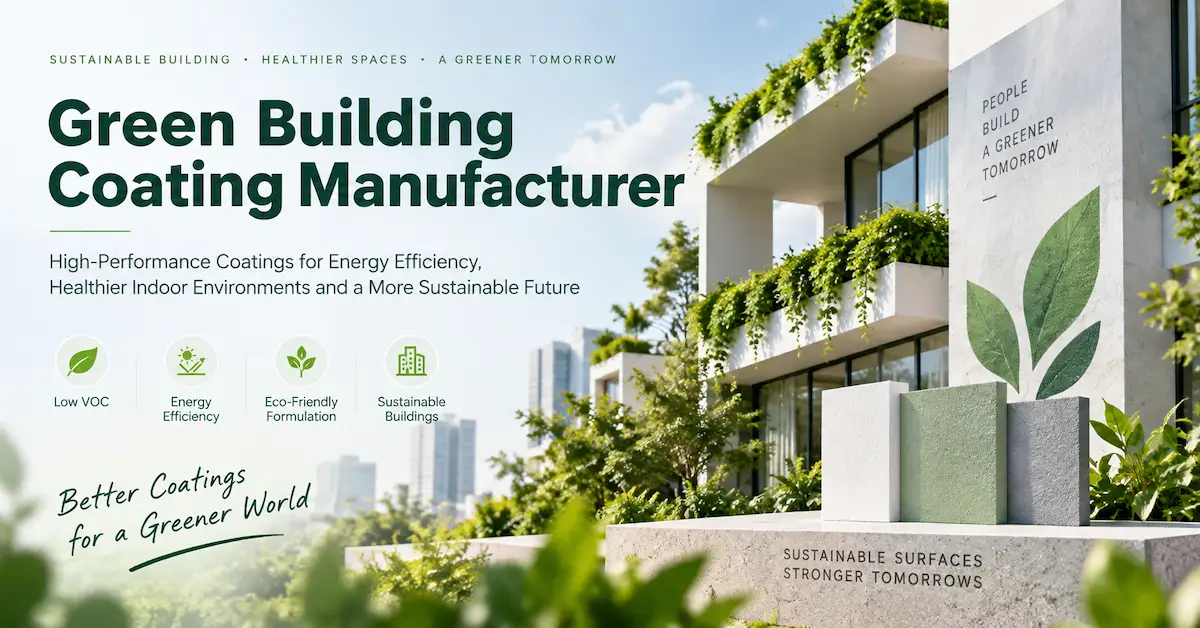
Choosing a green building coating manufacturer requires more than finding a supplier that offers water-based paint or uses environmentally friendly language. For developers, architects, contractors, and international coating distributors, the real challenge is selecting products that meet environmental requirements while providing reliable performance throughout the building's intended service conditions.
A suitable manufacturer should help buyers evaluate VOC content and emissions, coating-system compatibility, durability, product documentation, application requirements, and long-term maintenance. Where a green building certification or purchasing specification applies, environmental claims must be supported by evidence relevant to the exact product and project.
For buyers managing residential developments, offices, schools, hotels, commercial buildings, and renovation programs, the most responsible coating choice is one that balances documented environmental performance with technical suitability and maintainable service life.
At VERDA, architectural paints, primers, waterproofing materials, floor coatings, and industrial protective systems are organized around different building applications. The company also provides product selection, color matching, technical documentation coordination, and OEM/private-label discussions for professional buyers.
This guide explains how to evaluate a coating supplier, what evidence to request, which technical questions matter, and how to prepare a more effective procurement specification.
1. What Is a Green Building Coating Manufacturer?
A green building coating manufacturer develops or supplies coating products intended to meet defined environmental objectives alongside building-performance requirements.
Those objectives may concern indoor chemical emissions, VOC content, hazardous substances, product transparency, resource efficiency, coating durability, packaging, or the environmental consequences of maintenance and replacement.
The precise requirements depend on the building's location, application, occupants, certification scheme, and purchasing specifications.
A responsible manufacturer should therefore help buyers distinguish between three different questions:
-
Environmental characteristics: What evidence supports the coating's VOC, emissions, chemical, or lifecycle claims?
-
Technical suitability: Will the specified coating system perform on the intended substrate under actual exposure and maintenance conditions?
-
Procurement reliability: Can the supplier provide identifiable products, applicable documents, approved samples, consistent specifications, and a workable supply arrangement?
These questions are connected but should not be treated as interchangeable.
For example, a coating with documented low chemical emissions may be appropriate for an interior office wall, but that characteristic alone does not establish its suitability for an exposed roof, industrial floor, or coastal facade.
Similarly, a durable exterior coating may help reduce repeated repainting, but durability does not automatically establish low environmental impact without relevant comparative evidence.
The strongest green building specifications combine environmental requirements with the coating system's actual function.
2. Why Sustainable Coating Selection Matters to B2B Construction Buyers
Coatings influence more than the appearance of a building. They affect the surfaces occupants encounter, maintenance frequency,施工 access, cleaning requirements, and the resources consumed during application and future refurbishment.
Different buyers evaluate these consequences from different perspectives.
|
B2B buyer |
Main purchasing concern |
What the coating manufacturer should help clarify |
|---|---|---|
|
Real estate developers |
Material suitability, maintenance, project documentation |
Complete coating-system options, durability considerations, supply coordination |
|
Architects and specification consultants |
Environmental evidence, finish appearance, specification compliance |
Applicable test reports, TDS, color samples, system descriptions |
|
General contractors |
Application risks, substrate preparation, scheduling |
Primer compatibility, application conditions, recoat and curing requirements |
|
Government and school procurement teams |
Documentation, indoor-environment requirements, tender compliance |
Product-specific environmental evidence, safety documents, performance information |
|
Building material importers |
Market compliance, product differentiation, recurring supply |
Product classifications, documentation availability, packaging and labeling |
|
Private-label coating brands |
Formulation direction, market positioning, product claims |
OEM options, sample approval, supported claims, documentation |
|
Property and facility managers |
Maintenance cost, repainting disruption, finish durability |
Cleaning suitability, repair methods, recoating plans |
A green building coating manufacturer should understand these differences rather than recommending the same product to every customer.
For example, a hotel developer may prioritize interior finish consistency and repainting schedules, while a school procurement team may place greater emphasis on documented indoor emissions and cleaning requirements.
A coastal property developer may need to focus first on weather resistance, substrate preparation, water ingress, and suitable facade protection.
VERDA's coating support for builders and developers addresses material selection, technical documentation, color references, and project supply coordination across residential and commercial applications.
3. Water-Based, Low-VOC, and Low-Emission Coatings: What Is the Difference?
One of the most important procurement mistakes is assuming that water-based, low-VOC, low-odor, and low-emission coatings mean exactly the same thing.
They do not.
Each term describes a different characteristic, and purchasing specifications should identify which characteristic must be verified.
Water-Based Coatings
Water-based or waterborne coatings use water as the primary dispersing medium.
They are widely used for architectural walls, primers, and certain protective or flooring applications.
Depending on the formulation, waterborne systems may offer practical advantages in handling, application, or solvent-use reduction compared with particular solvent-based alternatives.
However, water-based does not automatically mean VOC-free, low-emitting, non-toxic, or compliant with a specific green building program.
A waterborne coating may still contain coalescents, additives, preservatives, or other ingredients that require evaluation.
The relevant environmental properties must be determined from the actual formulation and supporting documentation.
Low-VOC Coatings
VOC content generally concerns the amount of regulated volatile organic compounds associated with a product under a defined measurement method.
Architectural coating regulations commonly distinguish between product categories and establish different content limits.
For procurement purposes, a buyer should request the reported VOC value, its units, the applicable test or calculation method, the coating category, and the regulatory definition being applied.
A statement such as "low VOC" is incomplete unless the buyer knows which limit it is intended to satisfy.
Low-Emission Coatings
VOC emissions testing concerns chemicals released from a product into air under specified test conditions.
For indoor coating applications, emissions testing can be more directly relevant to exposure assessment than VOC content alone.
A laboratory chamber evaluation may consider the emission behavior of a coating after application and conditioning. The results depend on the test method, loading conditions, exposure scenario, measurement schedule, and substances evaluated.
Importantly, a low VOC-content result and a compliant emissions test are not interchangeable documents.
Comparison of Common Environmental Terms
|
Term |
What it describes |
What it does not prove |
|---|---|---|
|
Water-based |
Primary dispersing medium |
Automatic low VOC emissions or green building compliance |
|
Low VOC |
VOC content relative to a specified method or limit |
Low emissions of every potentially relevant chemical |
|
Zero VOC |
A claim based on a particular definition or test approach |
Absolute absence of all volatile chemicals |
|
Low odor |
Sensory characteristic during or after application |
Absence of hazardous emissions |
|
Low emitting |
Performance under a defined emissions evaluation |
Suitability for every use or building program |
|
Formaldehyde-free |
A formulation or product claim requiring definition |
Zero formaldehyde emissions under every condition |
|
Eco-friendly |
Broad environmental marketing description |
Independent certification or quantified lifecycle benefits |
|
EPD available |
Environmental impacts disclosed through a defined declaration |
That a product necessarily has lower impacts than alternatives |
The practical conclusion is simple: request the evidence behind the claim rather than selecting a coating because of the claim itself.
Buyers evaluating water-based architectural systems can begin with VERDA's architectural coating products and then request the documents relevant to their project specifications.
4. How Green Building Programs Affect Coating Procurement
Environmental purchasing requirements vary by country, building certification system, and project version.
For example, LEED evaluates buildings and projects rather than automatically certifying every product used in them.
A paint manufacturer may supply products whose documentation can support an applicable project credit, but that is not the same as claiming that an individual paint is "LEED certified."
LEED and Low-Emitting Materials
Within relevant LEED rating systems, interior paints and coatings may be evaluated under low-emitting materials requirements.
The specific criteria depend on the selected rating system and version.
For instance, LEED v4.1 references both VOC emissions evaluation and VOC content evaluation for applicable interior paints and coatings. LEED v5 includes updated material evaluation structures, making it particularly important to check the registered project's applicable requirements rather than relying on an older generic checklist.
Documentation may involve the California Department of Public Health Standard Method, an appropriate regulatory VOC content criterion, or other accepted compliance routes specified by the relevant version.
A buyer should confirm the following before treating a coating as a potential contributor to project compliance:
-
Which rating system and version is the project using?
-
Which product category includes the intended coating?
-
Does the requirement concern VOC content, emissions, or both?
-
Which test methods and documentation routes are acceptable?
-
Does the report cover the exact coating formulation, color or tinting conditions where relevant, and product identifier?
-
Is the report current and applicable to the project's intended use?
Do not assume that a manufacturer's general sustainability policy is sufficient evidence for a specific material credit.
Other Regional and Project Requirements
Projects outside the United States may reference European, national, municipal, or owner-specific coating criteria.
For example, the European Decorative Paints Directive 2004/42/EC addresses VOC content limits for specified decorative coating categories. Other projects may reference recognized emissions evaluation approaches or independent product certification programs.
The applicable requirements depend on the product classification and location.
When sourcing internationally, the purchasing team should obtain the project's required standards and confirm that the proposed products can be documented against them.
Procurement rule: A manufacturer's statement of compliance should identify the product, requirement, supporting test or declaration, and applicable scope. Generic environmental language cannot replace product-specific evidence.
5. The Seven Technical Criteria Buyers Should Evaluate
Selecting a green building coating manufacturer involves more than environmental documentation. Performance must also support the building's intended use.
5.1 Substrate Compatibility and Surface Preparation
The same wall coating cannot be assumed suitable for every substrate.
Concrete, cement mortar, plaster, gypsum board, previously painted surfaces, and metal components have different surface and adhesion requirements.
A suitable system may require substrate cleaning, repair, moisture checks, primer selection, or compatibility testing.
For renovation projects, existing coatings may also affect adhesion and require additional preparation.
A lower-emission product that fails prematurely because of poor substrate compatibility can create unnecessary removal, reapplication, material consumption, and project disruption.
5.2 Durability and Maintenance Requirements
Durability should be defined through the project's relevant performance criteria.
Exterior coatings may be assessed for weathering, ultraviolet exposure, water resistance, color retention, and other conditions.
Interior coatings may need resistance to cleaning, staining, abrasion, or repeated maintenance.
Rather than asking whether a coating is simply "durable," buyers should identify which service conditions it must resist and request applicable test evidence.
5.3 Application and Curing Conditions
Temperature, humidity, airflow, substrate moisture, film thickness, and recoating intervals can affect a coating's application and final performance.
A project may also impose occupancy deadlines or restrict solvent use during renovation.
The supplier should explain the recommended application method and provide suitable technical instructions.
5.4 VOC and Emissions Documentation
A technical product sheet may describe general performance, but environmental compliance may require additional reports.
Buyers should distinguish content declarations, emissions testing, safety documents, and third-party certifications.
5.5 Primer and Topcoat Compatibility
Environmental purchasing decisions should cover the complete coating system.
A selected low-emission topcoat does not automatically make the entire installed system compliant when the primer, sealer, or other applied products have separate requirements.
For specification purposes, request information on every relevant layer.
5.6 Color and Finish Consistency
Commercial developments often require the same finish across multiple buildings or construction phases.
Color consistency, gloss level, tinting practices, and sample approval should be defined before bulk supply.
Different tinting materials can also affect product characteristics. Therefore, environmental evidence should be checked for the actual product configuration when required by the test or specification.
5.7 Technical Support and Repeat Supply
For large developments, maintaining the approved specification across construction phases is as important as selecting the original product.
Buyers should establish how changes to formulation, packaging, labeling, or color will be communicated and reviewed.
A reliable cooperation process should make the technical expectations clear before the first large order.
6. Selecting Coating Systems for Different Green Building Applications
A green building procurement program should not rely on a single coating type for all surfaces.
Interior finishes, exterior facades, wet areas, industrial floors, and metal components have different technical demands.
The appropriate product must be selected for its function before environmental performance can be assessed against the relevant project requirements.
|
Building application |
Main requirements |
Coating-system considerations |
Environmental and technical evidence to request |
|---|---|---|---|
|
Residential interior walls |
Appearance, cleaning, occupant-related requirements |
Interior primer plus decorative wall paint |
VOC content, emissions reports where applicable, TDS, SDS |
|
Schools and learning environments |
Finish maintenance, indoor-material criteria, application schedule |
Interior wall coating and compatible primer |
Product-specific indoor emissions and relevant safety documentation |
|
Hotels and commercial offices |
Consistent appearance, renovation efficiency, cleaning |
Interior sealer, wall paint, color-matched finish |
Compliance documents, color approvals, cleaning performance |
|
Exterior building facades |
Sunlight, rain, weathering, maintenance |
Exterior primer plus weather-resistant topcoat |
Weathering data, adhesion, water resistance, application specifications |
|
Exposed roofs and balconies |
Water ingress, UV exposure, cracks, movement |
Appropriate waterproofing system |
Waterproofing performance, flexibility, exposure limits, system compatibility |
|
Warehouses and parking areas |
Mechanical wear, cleaning, traffic |
Epoxy, waterborne epoxy, or other suitable floor systems |
Abrasion, adhesion, chemical exposure, cure and application data |
|
Building metal components |
Corrosion, climate, repainting requirements |
Compatible industrial primer and protective topcoat |
Corrosion resistance, surface preparation, film thickness, environmental data as required |
Interior Walls: Evaluate the Complete Decorative System
For interior walls, buyers should begin with the substrate and environmental requirements of the occupied space.
A typical specification may combine a sealing primer and decorative topcoat. Both products should be checked for suitability and any applicable low-emitting materials requirement.
Depending on the project, attention may also be given to surface washability, covering ability, finish appearance, local regulations, and application scheduling.
The VERDA residential and commercial building coating solutions page outlines primer and interior wall coating options for apartments, offices, hotels, schools, and other occupied buildings.
Exterior Facades: Durability Is an Important Environmental Consideration
Exterior facade coatings are exposed to conditions that may include ultraviolet radiation, rain, temperature fluctuations, atmospheric dirt, and biological growth.
A coating selected only for its water-based formulation may fail to meet the exposure requirements.
Instead, buyers should compare the specified primer and topcoat system, substrate condition, weathering performance, maintenance expectations, and project-specific environmental criteria.
A properly selected durable system can help avoid premature replacement, although any quantified reduction in lifecycle environmental impact requires suitable comparative data.
Wet Areas and Waterproofing: Preventing Avoidable Repair
Bathrooms, balconies, roofs, and other moisture-sensitive areas require waterproofing materials selected for their particular conditions.
A membrane protected beneath tiles is not necessarily interchangeable with a coating exposed to sunlight or standing water.
Crack movement, water exposure, substrate preparation, and layer compatibility should all be evaluated.
VERDA's building waterproofing systems cover indoor wet areas, exposed roofs, water-retaining structures, and leakage repairs.
Products used in drinking-water contact or other sensitive applications require additional approval and safety evaluation appropriate to the intended use.
Floors: Environmental Selection Must Include Service Conditions
Industrial and commercial floor coatings may be exposed to mechanical traffic, cleaning chemicals, moisture, and operational restrictions.
A waterborne flooring option may be worth evaluating where the formulation and application conditions are suitable, but it is not automatically the best selection for every industrial floor.
The VERDA industrial floor coating solutions page provides information on waterborne epoxy, solvent-free epoxy, polyurethane mortar, and other floor-system pathways.
For a project-specific selection, buyers should compare complete systems, not simply the environmental terminology used in product names.
7. VERDA Coating Options for Environmentally Considered Building Projects
VERDA's portfolio includes water-based architectural paints and primers as well as waterproofing and floor-protection systems.
The following products are relevant starting points for buyers evaluating coating options for environmentally focused construction projects.
Important distinction: The listed product types, applications, and marketed features are drawn from VERDA's published product and solution information. Inclusion in this table does not mean that a specific product has been independently verified as low-emitting, LEED-compliant, EPD-covered, or certified under a particular ecolabel.
|
VERDA product |
Website-described characteristics |
Potential application discussion |
Information to verify |
|---|---|---|---|
|
JFC-003 Interior Wall Paint |
Water-based; marketed with formaldehyde-related, antibacterial and low-odor features |
Residential and commercial interiors |
Product-specific emissions, formulation claims and relevant test reports |
|
NAB-130 Interior Wall Primer |
Water-based sealing primer; promotes surface closure and adhesion |
Interior substrate preparation |
Primer compatibility, application and environmental data |
|
PMW-01 Interior Wall Primer |
Water-based; marketed as low-odor and mildew-resistant |
Interior wall coating systems |
VOC documentation, emissions where required, substrate conditions |
|
WEW-01 Exterior Wall Paint |
Water-based; weather-resistant, mildew-resistant, satin finish |
Residential and commercial facades |
Weathering performance, VOC data, substrate compatibility |
|
SJW-200 Exterior Wall Paint |
Water-based; self-cleaning positioning and semi-gloss finish |
Facades where surface cleanliness matters |
Self-cleaning test conditions, weathering and maintenance |
|
AW-101 Exterior Wall Paint |
Water-based; anti-fouling and weather-resistant positioning |
Exterior building maintenance |
Anti-fouling claims, environmental suitability and performance |
|
PETP-335 Exterior Primer |
Exterior sealing primer; adhesion and surface preparation |
Exterior primer and topcoat systems |
Substrate suitability, compatibility and technical specifications |
|
EF-WD130 / EF-WZ608 / EF-WM532 |
Waterborne epoxy floor-system components listed in VERDA solutions |
Selected industrial and commercial floors |
Complete system data, installation limits and environmental evidence |
Interior Coating Example: JFC-003 and Compatible Primers
VERDA presents JFC-003 Formaldehyde-Free Interior Wall Paint as a water-based decorative coating with formaldehyde-related and antibacterial product claims.
For projects that require substantiated indoor environmental performance, these claims should be supported by specific laboratory reports showing what was tested, the method used, the result, and the scope of the claim.
The buyer should also evaluate the selected primer. NAB-130 Closed Interior Wall Primer is presented as a water-based sealing and adhesion-supporting product, while PMW-01 Interior Wall Primer is positioned for low-odor and mildew-resistant interior applications.
Actual primer-to-topcoat pairing should be confirmed with VERDA rather than inferred from product category alone.
Exterior Coating Example: WEW-01 and PETP-335
For building facade projects, VERDA offers WEW-01 Weather-Resistant Exterior Paint, described as a water-based product with satin appearance and outdoor weather-protection characteristics.
The PETP-335 Exterior Primer is presented as an exterior sealing primer.
A project team could discuss these products as part of a candidate facade coating system, but should obtain confirmation of their mutual compatibility, the required substrate preparation, coating consumption, application conditions, and any relevant environmental evidence.
What These Products Demonstrate—and What They Do Not
These products demonstrate that VERDA offers architectural and building-related coating options relevant to discussions about responsible material selection.
They do not, by themselves, demonstrate that the whole portfolio meets one environmental certification or has an identical VOC profile.
For a green building specification, every proposed product should be assessed against the requirements that apply to that particular product and application.
That is a more credible basis for supplier selection than treating an entire manufacturer's catalog as automatically environmentally certified.
8. Which Documents Should a Green Building Coating Manufacturer Provide?
Technical and environmental documentation is one of the clearest ways to differentiate a serious B2B coating supplier from a seller relying primarily on marketing descriptions.
However, not all documents answer the same question.
A technically complete procurement package should distinguish product application data, safety information, emissions evidence, environmental declarations, and project-specific compliance documentation.
Essential Documentation Comparison
|
Document |
Main purpose |
How procurement teams should use it |
|---|---|---|
|
Technical Data Sheet (TDS) |
Product properties and application requirements |
Review recommended use, substrate, application, film build, drying and limitations |
|
Safety Data Sheet (SDS) |
Hazard communication and safe handling |
Review hazards, storage, transport-related considerations and handling guidance |
|
VOC Content Test or Declaration |
Document VOC content under a defined method |
Compare against the applicable coating-category limit |
|
VOC Emissions Report |
Evaluate emissions under defined testing conditions |
Assess relevant indoor low-emitting material requirements |
|
Environmental Product Declaration (EPD) |
Report environmental impacts using a defined lifecycle methodology |
Evaluate disclosed environmental-impact indicators and declaration scope |
|
Health Product Declaration (HPD) |
Communicate product ingredient information through a reporting framework |
Support material ingredient transparency review |
|
Third-Party Product Certification |
Demonstrate conformity to specified program criteria |
Verify exact product, certification scope, version and validity |
|
Product Application Guide |
Describe appropriate preparation and application methods |
Support contractor training and site procedures |
|
Color Approval Record |
Establish approved appearance criteria |
Control color consistency across phases and orders |
|
Manufacturer Declaration |
State a defined product property or conformity claim |
Review its supporting evidence and permitted use |
An SDS should never be presented as proof of low indoor emissions.
Similarly, an EPD provides environmental-impact disclosure; it does not automatically prove that a coating is the lowest-impact option or meets a particular indoor air quality requirement.
An HPD is an ingredient-transparency document, not a blanket declaration that a coating is harmless.
A supplier that understands these distinctions can help procurement teams avoid documentation failures later in the project.
VERDA maintains a TDS and SDS Download Center for available technical and safety documents. Buyers should confirm whether the exact product and document version needed for their project are currently available.
How to Review a VOC Emissions Report
When an interior coating must satisfy a low-emitting materials requirement, the buyer should examine more than the cover page of a test report.
Check the product identification, laboratory, test method, relevant exposure scenario, test date, measured substances, performance conclusion, and any restrictions.
Confirm whether the tested formulation represents the actual product being purchased.
A report for one base formulation should not automatically be assumed to cover every color, tint, packaging variation, or reformulated product.
If there is any uncertainty, request clarification from the manufacturer and the project's sustainability consultant.
How to Review an EPD
An Environmental Product Declaration should identify its program operator, product scope, applicable Product Category Rules, lifecycle stages, declared or functional unit, verification status, and validity.
When comparing two EPDs, ensure that the products and assessment boundaries are genuinely comparable.
A lower reported impact for one indicator does not necessarily mean that a product is environmentally preferable in every category or application.
For an installed coating system, consumption rate, expected service life, maintenance, and system components may also affect the project-level interpretation.
Documentation Red Flags
Procurement teams should investigate when a supplier offers only marketing brochures in response to a request for technical evidence, provides documents for a different product, or makes a certification claim without identifying the certifying program.
Other warning signs include outdated reports, missing formulation identifiers, contradictory TDS and packaging information, and the inability to clarify the difference between VOC content and chemical emissions.
9. Why Coating Durability Belongs in a Sustainable Procurement Strategy
A coating that requires frequent replacement can create additional material demand, labor, transport, surface preparation, and waste.
For that reason, durability and maintainability deserve attention alongside environmental product characteristics.
However, it is important not to overstate the relationship. A longer-lasting coating is not automatically the environmentally preferable coating in every situation.
A meaningful comparison should consider the impacts and useful life of complete alternatives under equivalent conditions.
Initial Cost Versus Lifecycle Cost
For B2B buyers, the lowest purchase price is not always the lowest total cost of maintaining a coated surface.
A practical cost comparison can consider:
Lifecycle coating cost = Initial materials + Surface preparation + Application labor + Maintenance + Future recoating + Waste management + Operational disruption
The relative importance of each component depends on the project.
An occupied hotel may face significant disruption from repainting public areas. A remote commercial facade may require expensive access equipment. A factory floor may require production downtime.
These factors can make lifecycle planning commercially important, even when the original material price difference appears small.
A Practical Recoating Comparison
Consider two candidate facade coating systems.
System A has a lower initial material cost but may require more frequent maintenance under the specified exposure conditions.
System B has a higher initial cost but comes with documented performance data indicating that it may support a longer planned maintenance interval under comparable conditions.
The procurement team should not choose System B merely because the manufacturer advertises superior durability.
Instead, it should compare test evidence, exposure conditions, warranty terms if any, substrate requirements, expected maintenance, and the cost of future access.
Only then can a defensible whole-life purchasing decision be made.
Coating Failures That Can Increase Material Waste
Premature failure can result from several causes that are not necessarily defects in the paint itself.
Common examples include unsuitable primer selection, application over damp substrates, insufficient cleaning, incompatible existing coatings, incorrect film thickness, inadequate curing, and exposure beyond the product's design limits.
The buyer should therefore assess both the coating and the installation process.
Environmental goals are better supported when the product performs as intended and avoidable rework is reduced.
VERDA explains this approach on its Sustainability and Responsibility page, which emphasizes selecting coating routes according to actual applications and aligning product, packaging, and project requirements to reduce unnecessary rework.
10. Estimating Coating Consumption Without Creating False Environmental Savings Claims
Material consumption influences procurement costs, packaging quantities, storage needs, delivery planning, and potential waste.
A coating quantity calculation is therefore useful for both commercial planning and responsible material management.
However, theoretical coverage must not be confused with guaranteed site consumption.
Basic Project Quantity Method
For a conventional coating estimate:
If an assumed loss factor is used, the procurement estimate can be adjusted:
For example, consider a hypothetical project involving 1,200 m² of wall surface, two topcoats, a theoretical spreading rate of 8 m²/L per coat, and an assumed 10% material loss.
|
Estimating factor |
Illustrative value |
|---|---|
|
Wall area |
1,200 m² |
|
Topcoat applications |
2 |
|
Assumed coverage |
8 m²/L per coat |
|
Theoretical topcoat quantity |
300 L |
|
Assumed loss fraction |
10% |
|
Adjusted estimate |
Approximately 333 L |
This is an estimating example, not a performance specification for any VERDA product.
The real calculation should use the selected product's applicable coverage data, surface porosity, specified film thickness, application method, texture, and expected waste.
Primer consumption must be calculated separately where a primer is required.
For project planning, buyers may also use VERDA's coating usage calculator, together with the latest product information.
Why This Matters for Green Procurement
Better quantity planning can help reduce over-ordering and unnecessary leftover material.
Accurate estimates may also improve packaging selection, delivery scheduling, and staged supply planning.
But a reduction in ordered liters should not automatically be presented as a quantified reduction in carbon emissions. Such claims require an appropriate calculation methodology and supporting data.
11. How to Evaluate a Green Building Coating Manufacturer Before Placing a Bulk Order
Finding a supplier with an attractive product catalog is only the beginning.
For international construction procurement, supplier evaluation should consider product traceability, technical communication, manufacturing coordination, document quality, and the ability to maintain approved specifications across repeat orders.
Manufacturer Evaluation Checklist
|
Evaluation area |
Questions to ask |
Evidence or response to request |
|---|---|---|
|
Company identity |
Who is the legal manufacturer and who is responsible for production? |
Company information and documented manufacturing arrangements |
|
Product specialization |
Which architectural coatings are suitable for the target project? |
Product descriptions, categories, application recommendations |
|
Environmental documentation |
Can claims be supported for the specific product? |
Applicable VOC tests, emissions reports, declarations or certificates |
|
Technical competence |
Can the supplier explain coating-system compatibility? |
TDS, application guidance, technical discussion |
|
Quality control |
How are approved specifications maintained between orders? |
Relevant testing procedures, acceptance criteria, batch identification |
|
Product samples |
Can sample materials be evaluated before bulk purchasing? |
Agreed sample and approval process |
|
Customization |
Can colors, packaging or formulations be discussed? |
OEM scope and feasibility confirmation |
|
Supply planning |
How will phased construction or repeat orders be coordinated? |
Agreed quantities, lead times and commercial arrangements |
|
Market suitability |
Can the product documentation support the destination market? |
Required documents and regulatory responsibilities |
|
After-sales communication |
How are technical issues and future orders handled? |
Defined support process and contact responsibilities |
Evaluate Evidence, Not Manufacturer Size Alone
A large factory does not automatically produce a coating suitable for a green building project.
Similarly, a smaller specialist supplier may offer relevant technical expertise but still need to demonstrate its actual production, documentation, and supply capabilities.
The most useful qualification criteria are those directly connected to the purchase.
For example, a school development may require product-specific emissions documentation, while an exterior facade contract may prioritize tested weathering performance and long-term supply consistency.
Verify Formulation and Batch Consistency
For multi-stage construction, ask whether the same approved product specification can be maintained across deliveries.
Confirm how batch identification, retained specifications, and changes to raw materials or formulations are handled.
If a change could affect an environmental claim or approval document, determine whether additional evaluation would be necessary.
This is especially important when a project relies on a specific product test report or approved sample.
Understand the Scope of Quality Certificates
Quality-management certifications, environmental-management certifications, and product-performance certifications serve different purposes.
For example, ISO 9001 concerns a quality-management system, while ISO 14001 concerns environmental management. Neither automatically proves that a particular coating meets a project-specific VOC emissions limit.
Procurement teams should verify the certificate holder, scope, issuing body, and validity rather than assuming that a certificate applies to every product.
12. OEM and Private-Label Green Building Coatings: What Brand Owners Should Confirm
Importers and distributors developing their own architectural coating brands face additional challenges.
They must consider both the technical product and the claims that will appear on packaging, websites, catalogs, and sales materials.
An OEM product positioned for environmentally conscious building markets should be built around clearly defined performance and documentation requirements.
Define the Market Before Defining the Formula
A private-label buyer should specify the intended sales country, customer group, application, target coating category, expected price range, and required documentation.
For example, a private-label line serving residential interior renovation may have different environmental and application priorities from a line intended for large commercial developments.
The manufacturer should determine whether a suitable existing formulation is available or whether a different product-development discussion is required.
Coordinate Environmental Claims and Packaging
The following information should be agreed before final packaging approval:
|
OEM requirement |
Why it matters |
|---|---|
|
Product category |
Determines the intended use and relevant regulatory classification |
|
Formula and performance target |
Establishes what the product is supposed to deliver |
|
Environmental claims |
Must be supported by evidence relevant to the actual formulation |
|
Target market |
Determines applicable labeling, language and compliance needs |
|
Packaging volume |
Affects distribution, storage, application and logistics |
|
Color range |
Requires achievable and repeatable tinting specifications |
|
Label language |
Supports local market communication |
|
Technical documentation |
Helps customers understand performance and use |
|
Sample approval |
Establishes the agreed product reference |
|
Change control |
Helps preserve approved specifications during repeat orders |
A private-label customer should not add "LEED certified," "zero emissions," "non-toxic," or similar claims merely because the base product is waterborne.
Claims must be checked against the actual product and relevant market requirements.
VERDA's OEM Cooperation Model
VERDA describes support for formulation discussions, product selection, packaging, labeling, samples, color references, technical documentation, and order planning.
Its OEM and Private Label Coating Services page outlines a process beginning with buyer requirements and moving through product selection, sample coordination, commercial confirmation, and production planning.
This can provide a useful starting point for international coating brands developing architectural product lines.
Specific environmental performance, certification, customization feasibility, minimum order quantity, and production timing should be confirmed for the proposed product rather than assumed from the general OEM service description.
Color Matching for Repeatable Commercial Projects
Color is another critical purchasing variable.
A multi-building development may need consistent wall colors across separate delivery phases, while a distributor may require a stable branded palette for repeated retail orders.
VERDA's Color Matching Service supports physical references, color-card matching, sample panels, and custom brand color discussions.
For repeat production, the buyer should approve a physical sample under suitable lighting and agree on color tolerance, gloss, finish, and record-keeping requirements.
Online color previews are useful for initial communication but should not replace final physical sample approval.
13. A Practical Green Building Coating Procurement Workflow
A structured procurement process helps reduce the risk of ordering a technically unsuitable or insufficiently documented coating.
The following workflow can be adapted for developers, contractors, distributors, and OEM customers.
Step 1 — Define the Project
Identify the building type, country, application areas, substrate conditions, exposure environment, project scale, and procurement schedule.
Step 2 — Establish Environmental Requirements
Record the relevant green building program, applicable version, VOC or emissions criteria, restricted substances, declaration requirements, and other tender conditions.
Step 3 — Shortlist Suitable Coating Systems
Match proposed products to interior walls, facades, roofs, floors, or protective applications. Evaluate the whole system and its actual operating conditions.
Step 4 — Review Technical and Environmental Evidence
Check product identifiers, TDS, SDS, relevant test reports, declarations, certification scope, and technical limitations.
Step 5 — Approve Samples and Application Conditions
Review physical samples, colors, finish quality, substrate compatibility, and any project-specific testing or mock-up requirements.
Step 6 — Calculate Quantity and Commercial Requirements
Estimate coating consumption, packaging needs, material loss, shipment quantities, phased deliveries, and total installed cost.
Step 7 — Confirm Supply and Acceptance Criteria
Agree on product identification, batch traceability expectations, approved documentation, labeling, order terms, and any requirements for repeat deliveries.
Step 8 — Verify Installation and Handover
Confirm application according to the approved specification, review inspection records, and preserve relevant product documents for building operation and maintenance.
What to Include in a Supplier RFQ
A qualified inquiry should provide enough information for the supplier to assess whether an appropriate product route is available.
At minimum, include the following project information:
|
RFQ field |
Example buyer input |
|---|---|
|
Project type |
Commercial office renovation |
|
Destination market |
Country and city |
|
Application |
Interior walls and corridors |
|
Substrate |
Existing painted plaster and new cementitious surfaces |
|
Approximate area |
4,000 m² |
|
Required coating system |
Primer and decorative topcoat |
|
Environmental criteria |
Specific project low-emitting materials requirement |
|
Finish |
Matte or satin, specified color references |
|
Technical documents |
TDS, SDS, relevant emissions evidence |
|
Procurement plan |
Estimated quantity and target delivery schedule |
|
Additional needs |
Physical samples, color matching, OEM packaging if applicable |
Providing this information helps the supplier avoid recommending products based only on a broad term such as "eco-friendly paint."
It also makes early technical and commercial communication more productive.
14. How VERDA Can Support Green Building Coating Discussions
VERDA positions its coating business around architectural applications, waterproofing, industrial flooring, protective coatings, and professional B2B supply.
Its website also identifies distributors, builders, architects, contractors, and OEM brand owners as important customer groups.
For environmentally focused projects, the most relevant support areas are product-route selection, water-based coating discussions, compatible system planning, technical documentation coordination, colors, samples, and procurement communication.
Product Selection Based on Application
Rather than recommending a single universal green paint, the initial discussion can begin with the building's actual application.
Interior wall projects may require a water-based primer and decorative coating.
Exterior projects may require weather-resistant facade systems.
Moisture-sensitive areas may require a dedicated waterproofing product, while commercial floors may require a coating chosen for expected traffic and cleaning conditions.
Environmental Requirements Should Be Confirmed Product by Product
VERDA's published Sustainability and Responsibility approach emphasizes matching environmental goals with practical coating requirements.
For a project with specific certification or environmental-documentation conditions, buyers should identify the exact product and obtain confirmation of which evidence is available.
This avoids extending one environmental claim to unrelated products or applications.
OEM and Project Supply Coordination
For distributors and private-label buyers, VERDA provides a channel for discussing product direction, packaging, labeling, samples, and technical information.
For developers and contractors, the discussion can focus on coating-system suitability, application conditions, project documentation, and material supply.
These different procurement routes can begin with the same principle: define the product requirements before requesting a final quotation.
Discuss Your Green Building Coating Requirements
Looking for coating options for a residential development, commercial building, architectural distribution program, or private-label product range?
Share your project location, application surfaces, environmental documentation requirements, preferred coating types, and estimated purchase volume with VERDA to discuss suitable products and available technical support.
15. Common Mistakes When Sourcing Green Building Coatings
Even experienced buyers can encounter specification and purchasing problems when environmental claims are not examined carefully.
Mistake 1: Assuming Every Water-Based Paint Is Low Emitting
Waterborne formulation and tested low-emission performance describe different characteristics.
Better approach: Request the required product-specific environmental evidence.
Mistake 2: Treating a Building Certification as a Product Certification
A coating may contribute to a building's material compliance, but that does not make the individual product LEED-certified.
Better approach: Identify the exact credit requirements and supporting documents rather than relying on a broad certification claim.
Mistake 3: Selecting Only the Topcoat
A complete system may include primers, sealers, intermediate coats, and finishing materials.
Better approach: Review all components necessary for the specified application.
Mistake 4: Ignoring Substrate and Climate
A suitable coating for an interior wall may not withstand exterior weathering or moisture exposure.
Better approach: Confirm substrate compatibility, environmental exposure, and application limitations before approving the product.
Mistake 5: Comparing Only Material Price
The least expensive coating may involve higher installation, maintenance, or future recoating costs.
Better approach: Compare total installed and maintenance costs alongside documented performance.
Mistake 6: Accepting Unverified Environmental Marketing
Terms such as "natural," "non-toxic," "green," or "zero emissions" may be used inconsistently.
Better approach: Request the test method, declaration, certification, and product scope supporting the claim.
Mistake 7: Assuming OEM Claims Transfer Automatically
A modified private-label formulation may not be covered by documents originally issued for another product.
Better approach: Confirm whether any change affects environmental evidence, labeling, or regulatory compliance.
Mistake 8: Failing to Plan Repeat Orders
If an approved product changes during a multi-phase project, technical and environmental consistency may be affected.
Better approach: Establish approved product identifiers and a change-notification process before bulk supply begins.
16. Frequently Asked Questions
Is water-based paint always considered a green building coating?
No. Water-based paint uses water as the primary dispersing medium, but the formulation alone does not establish low VOC emissions, restricted-substance compliance, or superior lifecycle performance.
Buyers should request evidence that matches the project's specific environmental criteria.
Can a green building coating manufacturer supply LEED-certified paint?
LEED is primarily a building and project certification system. Individual paints should not be described as LEED-certified simply because they are intended for LEED projects.
A manufacturer may offer products with documentation relevant to applicable LEED material requirements, but the project's rating-system version and evidence criteria must be confirmed.
What is the difference between low-VOC and low-emission paint?
Low-VOC generally describes a product's VOC content under a defined method or regulatory criterion.
Low-emission describes a product's emissions under specified testing conditions.
A buyer may need both types of information, depending on the application and environmental specification.
Which documents should architects request before specifying sustainable coatings?
Architects should request relevant technical data sheets, safety data sheets, environmental test reports, product declarations, and any required certification documents.
They should also review substrate compatibility, complete coating-system requirements, available finishes, and application guidance.
Not every project requires every document, so the documentation list should be aligned with the tender and applicable standards.
Are low-VOC coatings less durable than conventional coatings?
Not necessarily. Durability depends on the complete formulation, substrate, surface preparation, service environment, coating-system design, and application quality.
Product performance should be evaluated through relevant technical evidence rather than predicted from VOC terminology alone.
Can exterior wall coatings contribute to sustainable building goals?
Exterior coatings can be relevant to durability, maintenance, and material-use decisions.
However, their actual environmental contribution depends on product characteristics and the project context. A water-based exterior coating or a self-cleaning claim is not sufficient proof of lower lifecycle environmental impact.
What is the difference between an EPD and an SDS?
An EPD reports environmental impacts under a defined lifecycle-assessment and declaration framework.
An SDS provides hazard communication and safe-handling information.
Both may be useful to procurement teams, but they serve different purposes and should not replace each other.
Can a manufacturer customize environmentally focused coatings for private-label brands?
Customization may be possible depending on the product type, technical requirements, market, quantity, and manufacturing arrangement.
A brand owner should discuss the proposed formulation, packaging, labeling, performance targets, samples, and documentation before approval.
Any environmental claims must be reassessed when changes affect the covered product.
How can distributors compare two green building paint suppliers?
Distributors should compare verified product performance, documentation, target-market compatibility, product range, sample approval, quality control, packaging support, and repeat-supply arrangements.
A structured product and supplier checklist is more useful than comparing promotional claims or unit prices alone.
How can I request a green building coating quotation from VERDA?
Prepare information about the intended market, building type, application surfaces, environmental criteria, coating system, preferred finish, purchase quantity, and project schedule.
You can then submit the details through the VERDA contact page to discuss available products, technical documentation, samples, and commercial arrangements.
Conclusion
Selecting a green building coating manufacturer is ultimately an exercise in balancing environmental requirements, technical performance, and procurement reliability.
Water-based formulations, low-VOC claims, and sustainability positioning can provide useful starting points, but they do not replace product-specific evidence. Buyers should verify VOC content and emissions where applicable, examine relevant technical documentation, and confirm that the complete coating system is appropriate for the building's substrates, exposure conditions, and maintenance requirements.
For developers and architects, this approach supports more defensible material specifications. For contractors, it helps reduce avoidable application problems and rework. For importers, distributors, and OEM brand owners, it creates a clearer basis for product selection, compliant marketing, and repeat supply.
The most effective purchasing decision is not simply to choose the coating with the strongest environmental slogan. It is to select a documented, technically appropriate, and commercially practical coating system that matches the project.
VERDA offers architectural paints, primers, waterproofing materials, floor-protection systems, and B2B cooperation services that buyers can evaluate against their specific construction and sourcing needs.
Whether you are planning a commercial development, sourcing architectural coatings in bulk, or building a private-label paint range, start by defining the environmental and technical requirements that matter to your market.
Contact VERDA to Discuss Green Building Coating Solutions and Request Product Information