How to Choose an Exterior Wall Paint Manufacturer for Long-Term Building Performance
Choosing the right exterior wall paint manufacturer is an important sourcing decision for construction material importers, architectural paint distributors, private-label brands, building contractors, and real estate developers.
Exterior walls experience continuous exposure to sunlight, rainfall, humidity, airborne pollution, temperature changes, and biological contamination. The wrong coating system can lead to premature fading, peeling, chalking, moisture-related damage, or expensive repainting work.
For B2B buyers, these problems affect more than the appearance of a building. They can result in contractor complaints, warranty disputes, product returns, increased maintenance costs, and damaged relationships with distribution partners.
The most reliable sourcing approach is to evaluate the complete exterior coating system—not simply the paint price, bucket design, or manufacturer's marketing claims.
A qualified supplier should help buyers understand:
-
Which exterior paint is suitable for the local climate and wall substrate.
-
How primers and topcoats work together.
-
Which technical properties require testing and documentation.
-
How different finishes influence appearance and maintenance.
-
Whether the supplier supports OEM manufacturing and private-label packaging.
-
How color consistency, product quality, and repeat orders are managed.
-
What affects the real installed cost of an exterior painting project.
For buyers comparing manufacturers, the best choice is not necessarily the supplier with the lowest quotation. It is the supplier capable of matching product performance, documentation, application conditions, and commercial requirements to the intended market.
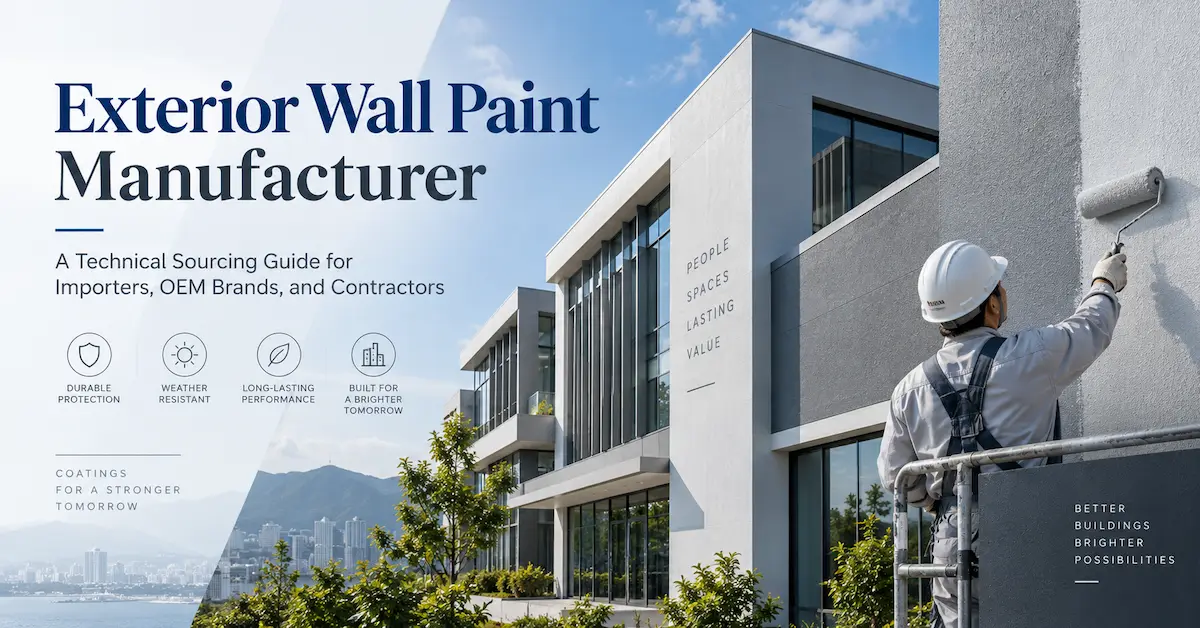
What Does an Exterior Wall Paint Manufacturer Actually Provide?
An exterior wall paint manufacturer develops and supplies protective and decorative coatings intended for outdoor building surfaces.
Depending on its production capabilities and commercial model, a manufacturer may support architectural paint formulation, raw material selection, production, packaging, color matching, technical documentation, and application guidance.
However, not every company advertising exterior paint has the same manufacturing responsibilities.
Some businesses develop and produce their own coating systems. Others manufacture under contract, provide private-label filling services, or distribute products sourced from independent factories.
These business models can all be useful, but buyers should understand exactly who is responsible for the product specification, quality control, and supply agreement.
Exterior Paint Manufacturer vs. Paint Supplier vs. Trading Company
| Supplier Type | Typical Responsibilities | What Buyers Should Verify |
|---|---|---|
| Coating manufacturer | Product development, production, filling, and technical coordination | Manufacturing scope, testing procedures, batch consistency |
| OEM paint manufacturer | Production and packaging for another brand | Formulation ownership, branding rights, minimum orders |
| Private-label paint supplier | Branded product supply and packaging coordination | Product source, label control, repeat-order consistency |
| Paint trading company | Product sourcing and commercial coordination | Actual manufacturing partner, accountability, technical access |
| Regional paint distributor | Local inventory, sales, and customer support | Product authorization, local documentation, stock continuity |
A trading company is not automatically a poor choice, and a factory is not automatically a better choice.
The deciding factor is whether the supplier can provide reliable product evidence, clear commercial responsibilities, and consistent technical support.
For buyers building a long-term paint distribution business, direct access to manufacturing and product development discussions may provide greater flexibility when selecting product grades, packaging specifications, or market-specific formulations.
VERDA positions itself as an integrated coating company combining research and development, manufacturing, and supply activities. Its business covers architectural paints and other coating systems, with support for standard products, customized formulation discussions, packaging solutions, and OEM manufacturing.
Buyers can review the company's broader capabilities on the VERDA About Us page.
Which B2B Buyers Need an Exterior Wall Paint Manufacturing Partner?
Different customers require different levels of technical and commercial support.
A building contractor purchasing paint for a single commercial facade has different priorities from an importer developing a branded product line for hundreds of retail outlets.
Importers and Wholesale Distributors
Importers typically need a product portfolio that fits regional construction practices, consumer preferences, and price expectations.
Their priorities often include:
-
Consistent product quality across shipments.
-
Appropriate technical documentation.
-
Packaging suitable for distribution.
-
Competitive landed cost.
-
Stable color and product specifications.
-
Predictable production and delivery planning.
A manufacturer that helps distributors establish a clear product range can reduce purchasing complexity and improve market positioning.
Private-Label and OEM Paint Brands
Private-label customers focus on product differentiation and repeatable manufacturing.
They may require custom branding, label language, packaging formats, color selection, and discussions about performance positioning.
For these buyers, the manufacturer must understand both coating technology and commercial product development.
Building Contractors and Project Buyers
Contractors generally prioritize practical application performance.
They need coatings compatible with the specified substrate, available施工 methods, environmental conditions, and project schedule.
Poor spreading characteristics, inadequate adhesion, or unsuitable recoat intervals can create substantial labor and material losses.
Architects, Developers, and Facility Managers
These buyers focus on appearance, building durability, specification compliance, and maintenance planning.
They may also require coating samples, technical submittals, color approval, or documentation for project procurement.
A strong exterior paint manufacturing partnership starts with understanding the buyer's business model—not recommending the same coating to every customer.
Exterior Wall Paint Selection by Climate and Exposure Environment
Climate suitability is one of the most important factors when selecting exterior architectural coatings.
A paint that performs adequately in a sheltered urban environment may encounter different stresses on a tropical coastal building or a commercial facade exposed to intense sunlight.
Climate-Based Exterior Paint Selection Matrix
| Climate or Environment | Primary Coating Challenges | Important Selection Criteria |
|---|---|---|
| Hot and sunny regions | UV exposure, pigment fading, thermal movement | Weathering resistance, color retention, suitable film flexibility |
| Tropical and humid regions | Frequent rain, prolonged humidity, fungal and algal growth | Moisture management, appropriate biological resistance, adhesion |
| Coastal regions | Salt deposits, wind-driven rain, high humidity | Substrate preparation, exposure compatibility, coating durability |
| Cold and freeze-thaw climates | Thermal cycling, moisture penetration, substrate movement | Water absorption, system flexibility, substrate compatibility |
| Industrial and polluted cities | Soot, dust, airborne contaminants, facade staining | Dirt pickup resistance, cleanability, maintenance planning |
| High-rainfall areas | Repeated wetting, water penetration, efflorescence | Liquid-water resistance, water-vapor behavior, moisture diagnosis |
These are selection considerations, not automatic product approvals. Final suitability depends on the complete coating system and verified product performance.
Exterior Paint for Hot and High-UV Regions
In regions with intense sunlight, UV exposure can contribute to polymer degradation, pigment changes, chalking, and loss of appearance.
Buyers should examine accelerated weathering data, color-change measurements, gloss retention, and exposure conditions.
A light-colored wall coating may also have different heat absorption characteristics from a dark-colored finish, even when both products use the same coating technology.
However, a lighter color alone does not guarantee acceptable long-term performance.
The binder, pigment system, coating thickness, application quality, and environmental exposure all influence durability.
Importers supplying hot-climate construction markets should request representative samples and confirm the suitability of the proposed coating grade before placing commercial orders.
Exterior Paint for Humid and Rainy Climates
High humidity and frequent rainfall introduce several possible failure mechanisms.
Masonry can retain moisture. Biological growth can develop on contaminated or persistently damp surfaces. Water entering cracks may contribute to blistering, staining, and adhesion failure.
These problems cannot always be solved by choosing a paint advertised as waterproof.
The manufacturer should help evaluate the wall condition, moisture source, primer compatibility, and intended exposure.
When fungal or algal resistance is an important purchasing requirement, ask for the relevant test method, results, and limitations rather than relying solely on a general anti-mildew claim.
Exterior Paint for Coastal Buildings
Coastal buildings can experience wind-driven rain, salt deposition, high humidity, and accelerated deterioration of vulnerable building components.
For masonry facades, a suitable exterior coating must be selected according to the substrate and moisture behavior.
For exposed steel accessories, handrails, or other metal components, a separate metal protective coating system may be necessary.
Exterior masonry paint should not be assumed to provide the same corrosion protection as a dedicated marine or industrial anti-corrosion system.
Coastal project buyers should evaluate the full building envelope and identify which surfaces require architectural coatings, waterproofing products, or metal protection.
Exterior Paint for Polluted Urban Environments
Commercial buildings near busy roads or industrial districts often accumulate soot and airborne contamination.
Facade appearance can deteriorate even when the coating remains physically intact.
In these situations, self-cleaning and anti-fouling coating options may be relevant.
However, the buyer should determine whether the manufacturer's claims refer to reduced dirt adhesion, easier cleaning, or another defined performance mechanism.
No coating should be assumed to remain permanently clean without maintenance.
Select the Complete Exterior Wall Coating System
One of the most common specification mistakes is evaluating exterior paint without considering the substrate and primer.
A successful facade coating depends on the interaction between the existing wall, surface preparation, primer, topcoat, and application conditions.
The Three Main Components of an Exterior Wall Painting System
1. Substrate preparation
The wall must be suitable for coating. Loose materials, incompatible existing paint, dust, contamination, excessive moisture, and unstable repair areas can interfere with adhesion.
2. Compatible exterior primer
A suitable primer may improve substrate sealing, reduce uneven absorption, and help establish a consistent foundation for the finishing coating.
3. Exterior topcoat system
The finishing coat provides the intended appearance and contributes to resistance against outdoor exposure.
The required number of coats, coverage rate, drying intervals, and final film thickness must follow the selected product's technical instructions.
Why Substrate Conditions Matter
Different surfaces present different risks.
| Substrate | Common Problem | Recommended Evaluation |
|---|---|---|
| New concrete | Moisture, alkalinity, curing condition | Confirm curing, dryness, surface soundness, and primer suitability |
| Cement render | Porosity, dusting, fine cracks | Check cohesion, absorption, repairs, and sealing requirements |
| Previously painted walls | Loose film, unknown coating chemistry | Test adhesion, remove defective material, assess compatibility |
| Exterior putty or skim coat | Weak surface cohesion, moisture sensitivity | Verify exterior suitability and surface strength |
| Fiber-cement panels | Joint movement, edge absorption | Follow panel manufacturer requirements and coating compatibility |
| Exterior insulation finish systems | System-specific permeability and flexibility needs | Obtain approval from the facade system supplier |
| Mixed masonry surfaces | Uneven absorption, repair patches | Prepare and prime appropriately to reduce finish variation |
A manufacturer should not recommend a single primer for every surface without reviewing the project.
For example, an existing wall with trapped moisture may require investigation and repair before any coating is applied.
Applying a stronger topcoat over an unresolved moisture problem can make the failure more expensive.
For building-specific system planning, explore VERDA's Residential and Commercial Building Coating Solutions.
Exterior Wall Paint Technologies: Acrylic, Silicone-Modified, and Elastomeric Systems
The coating binder influences film formation, flexibility, weathering behavior, and compatibility with the substrate.
Different binder technologies are used across the architectural coatings industry.
Not every coating manufacturer offers every chemistry, and a product's precise resin composition should be verified through its technical documentation.
Acrylic Exterior Wall Paint
Acrylic-based coatings are widely used for architectural surfaces because they can be formulated for decorative appearance, outdoor exposure, and different levels of performance.
However, acrylic paint is a broad category.
A product described as acrylic may differ significantly from another in binder composition, pigment quality, additive package, solids content, and durability.
Buyers should therefore avoid treating the word "acrylic" as a complete technical specification.
Silicone- or Siloxane-Modified Coatings
Some masonry coating systems use silicone- or siloxane-related technology to influence water repellency and other film properties.
Their suitability depends on the actual formulation and application requirements.
Claims concerning rain resistance or vapor permeability should be evaluated using relevant test results.
These technologies should not be assumed to be interchangeable with conventional acrylic coatings.
Elastomeric Exterior Coatings
Elastomeric coatings are developed for applications where specified film flexibility or crack-bridging performance is important.
Their performance depends on the coating system, application thickness, temperature, substrate, and validated test conditions.
An elastomeric coating does not replace structural crack repair, joint detailing, or a dedicated waterproofing membrane.
Buyers should ask for tested crack-bridging performance where this property is required.
Water-Based vs. Solvent-Based Exterior Coatings
Water-based exterior coatings are widely used in architectural applications and may offer practical benefits for handling and application.
However, "water-based" does not automatically mean zero VOC, low environmental impact, or compliance with every market's regulations.
A product's regulatory suitability must be evaluated against its actual composition, safety documentation, local rules, and applicable test methods.
For typical residential and commercial facades, the most important question is not simply which binder category sounds more advanced.
It is whether the complete coating system meets the building's performance and maintenance requirements.
Which Technical Specifications Should Buyers Request?
Professional buyers should compare measurable coating properties rather than relying only on product descriptions such as "premium quality," "long-lasting," or "excellent weather resistance."
A useful Technical Data Sheet should identify the product, intended use, application requirements, and available physical and performance properties.
Exterior Wall Paint Technical Evaluation Checklist
| Technical Property | Why It Matters | Questions to Ask |
|---|---|---|
| Binder or coating type | Helps identify the intended system | What is the documented formulation category? |
| Volume or weight solids | Supports coverage and film-build evaluation | Which solids measure is reported, and by what method? |
| Recommended coverage | Influences material quantity and cost | Is the rate theoretical or practical, and under what conditions? |
| Recommended film thickness | Affects the coating system specification | What wet and dry film thickness is required? |
| Adhesion | Helps evaluate bonding performance | Which substrate and test method were used? |
| Water absorption | Relevant to rain-exposed masonry | What test results support water-repellent claims? |
| Water-vapor transmission | Relevant to moisture movement through wall assemblies | Is permeability documented for the coating system? |
| Weathering resistance | Relates to outdoor durability | What exposure cycle and evaluation criteria were used? |
| Color change | Helps assess appearance retention | Are color differences measured before and after exposure? |
| Chalking resistance | Indicates surface deterioration | How was chalking evaluated? |
| Biological resistance | Relevant to humid climates | Are antifungal or antialgal claims supported by testing? |
| Drying and recoating | Affects contractor scheduling | What temperature and humidity conditions apply? |
| Storage stability | Important for import and distribution | What shelf-life and storage conditions are specified? |
Not every product requires every test. The specification should reflect the actual exposure conditions and the buyer's requirements.
Weathering and UV Resistance
Accelerated weathering tests can help compare coatings under defined laboratory conditions.
For example, ASTM G154 describes operation of fluorescent UV exposure equipment. It is an exposure practice, not a standalone certification of a coating's service life.
When reviewing weathering results, buyers should ask:
-
What equipment and exposure cycle were used?
-
How long were samples exposed?
-
Was the test performed on the actual specified coating?
-
How were color, gloss, cracking, and chalking evaluated?
-
Was a comparison product tested under equivalent conditions?
A claim such as "1,000 hours of weather resistance" has limited value unless the test conditions and performance results are explained.
Accelerated laboratory exposure hours should not be converted directly into a guaranteed number of outdoor service years.
Water Absorption and Vapor Permeability
Exterior masonry coatings must be evaluated within the building's moisture-management strategy.
Liquid-water resistance and water-vapor transmission are different properties.
A coating may limit rainwater absorption while allowing a defined level of water-vapor movement. Whether that combination is appropriate depends on the wall construction and environmental exposure.
For projects using European masonry coating classifications, EN 1062-related methods may be relevant. EN 1062-3 addresses liquid-water permeability, while ISO 7783 provides a method for determining water-vapor transmission properties.
Buyers should request actual results and confirm the applicable standard edition, classification, and product tested.
Neither a "breathable" description nor a "waterproof" label is sufficient evidence on its own.
Color and Gloss Retention
Visible facade performance matters to property owners, architects, and developers.
Differences in color or gloss may become noticeable across large exterior surfaces.
Test methods such as ASTM D2244 for instrumental color differences and ISO 2813 for specular gloss can help structure a technical evaluation.
For repeat purchases, buyers should agree on an approved reference sample and a suitable acceptance method.
A color code alone may not capture all variation caused by substrate texture, film thickness, lighting, or coating finish.
Comparing VERDA Exterior Wall Paint Products
VERDA offers architectural coating options for different exterior wall applications, decorative requirements, and B2B supply programs.
Its published exterior wall paint range includes weather-resistant, self-cleaning, and anti-fouling products, alongside exterior primer solutions.
VERDA Exterior Coating Product Comparison
| Product | Model | Published Finish | Main Product Positioning | Typical Buyer Consideration |
|---|---|---|---|---|
| Weather-Resistant Exterior Paint | WEW-01 | Satin | Water-based facade coating developed for outdoor weather exposure | General residential and commercial facades |
| Self-Cleaning Exterior Paint | SJW-200 | Semi-Gloss | Water-based coating positioned for reduced dirt accumulation and cleaner appearance | Urban commercial buildings and facade maintenance |
| Anti-Fouling Exterior Paint | AW-101 | Eggshell | Water-based coating positioned for reduced surface contamination | Residential and commercial renovation projects |
| Closed Exterior Primer | PETP-335 | First | Water-based exterior primer intended to improve surface sealing and coating foundation | Preparation of compatible exterior wall substrates |
These are product positioning details published by VERDA, not a quantified performance ranking.
Actual coverage, VOC content, film thickness, tested durability, compatible substrates, and final system selection should be confirmed through current technical documentation.
WEW-01: Weather-Resistant Exterior Wall Paint
VERDA WEW-01 Weather-Resistant Exterior Paint is presented as a water-based architectural coating with a satin finish.
The product is positioned for residential and commercial exterior surfaces where outdoor weather exposure and decorative appearance are important.
For project buyers, the relevant evaluation questions include weathering performance, primer compatibility, color requirements, and application conditions.
For distributors, the product may represent a general exterior facade coating category within a broader architectural paint portfolio.
SJW-200: Self-Cleaning Exterior Wall Paint
VERDA SJW-200 Self-Cleaning Exterior Paint is a water-based facade coating with a semi-gloss finish.
VERDA positions it for applications where reduced dirt accumulation and long-term exterior appearance are important.
This positioning may appeal to commercial property owners, distributors serving urban construction markets, and contractors working on visible architectural facades.
Buyers should confirm the testing and practical limitations behind the self-cleaning claim.
A self-cleaning coating should not be interpreted as eliminating all future washing or facade maintenance.
AW-101: Anti-Fouling Exterior Wall Paint
VERDA AW-101 Anti-Fouling Exterior Paint is positioned for reduced surface contamination, outdoor protection, and an eggshell decorative finish.
It is intended for architectural applications such as residential buildings, commercial buildings, and renovation projects.
For buyers comparing AW-101 with SJW-200, the essential distinction is not merely the wording of the product names.
The comparison should include verified dirt-resistance performance, finish appearance, substrate compatibility, application properties, and project-specific maintenance requirements.
PETP-335: Exterior Wall Primer
VERDA PETP-335 Closed Exterior Primer is a water-based exterior primer intended to provide surface sealing and improve coating foundation uniformity.
It can be considered during the evaluation of appropriate exterior wall systems.
However, buyers must verify compatibility between the primer, substrate, and selected topcoat rather than assuming all products are automatically interchangeable.
For additional products and coating categories, visit the VERDA Product Center.
Self-Cleaning vs. Anti-Fouling Exterior Paint: What Is the Difference?
Self-cleaning and anti-fouling are attractive terms in architectural coating marketing, but they can refer to different mechanisms and performance objectives.
Self-cleaning coatings may be designed to reduce dirt adhesion, promote removal of surface deposits under certain exposure conditions, or support easier maintenance.
Anti-fouling architectural coatings may be positioned to reduce the accumulation or retention of surface contamination.
The exact difference depends on how each product is formulated and tested.
What Buyers Should Compare
| Evaluation Area | Self-Cleaning Paint | Anti-Fouling Paint |
|---|---|---|
| Product objective | Support cleaner exterior appearance | Reduce surface contamination or dirt retention |
| Key verification | Defined cleaning or dirt-removal test | Defined dirt-pickup or contamination test |
| Exposure relevance | Rainfall, dust, surface texture | Pollution, airborne contaminants, local conditions |
| Maintenance expectation | Reduced cleaning effort may be a goal | Easier maintenance may be a goal |
| Specification risk | Assuming rain removes every type of dirt | Assuming the coating prevents all staining |
These descriptions explain general procurement considerations. They do not establish that every product marketed under either term performs in a particular way.
For a reliable comparison, the manufacturer should identify how performance was measured, under which conditions, and relative to what reference.
Contractors should also compare physical samples because semi-gloss and eggshell finishes can produce different visual effects on textured walls.
Why Exterior Primer Compatibility Matters
Primer selection is frequently underestimated during exterior paint procurement.
A suitable primer may improve adhesion, reduce uneven surface absorption, and create a more consistent base for the finishing system.
However, primer selection should depend on the condition of the actual wall.
Common Exterior Wall Primer Requirements
Porous cement render
A compatible sealing primer may help regulate uneven absorption and improve finishing consistency.
New alkaline masonry
The coating supplier should review curing conditions, alkalinity, moisture, and the need for an appropriate alkali-resistant system.
Previously painted surfaces
Existing paint must be evaluated for adhesion, contamination, and chemical compatibility.
Chalking or weak surfaces
The defective material should be removed or addressed appropriately. A primer should not be used to conceal an unstable substrate.
Repaired exterior walls
Repair compounds, surrounding surfaces, and existing coatings may absorb differently and require a controlled preparation process.
A primer does not repair structural movement, active leaks, or ongoing substrate deterioration.
When uncertain, buyers should submit substrate photographs, repair history, and project conditions to the supplier before approving the coating system.
Surface Preparation and Application: How Contractors Reduce Coating Failures
Even a technically suitable exterior coating can fail when applied over an unsuitable substrate.
Manufacturer selection therefore involves understanding the level of application support available.
Step 1: Inspect the Exterior Wall
Before painting, identify:
-
Loose, flaking, or chalking old coatings.
-
Efflorescence and moisture staining.
-
Cracks and movement joints.
-
Biological contamination.
-
Oil, grease, dust, or construction residues.
-
Repairs made with different materials.
-
Potential water-entry locations.
The inspection should distinguish surface defects from underlying building problems.
Step 2: Resolve Active Moisture Problems
Recurring efflorescence, blistering, or moisture staining may indicate that water is entering the wall or moving through the substrate.
Possible sources include leaking details, damaged sealants, plumbing, inadequate drainage, or other building-envelope defects.
These causes should be investigated before coating.
Painting over an active leak is not a durable repair strategy.
Step 3: Prepare a Sound Surface
Surface preparation may include cleaning, removal of defective coatings, substrate repairs, and treatment of biological contamination.
The appropriate process depends on the material and project conditions.
Cleaning methods should not damage the substrate or leave residues that interfere with coating adhesion.
Step 4: Confirm Environmental Conditions
Ambient temperature, substrate temperature, relative humidity, wind, and expected rainfall can influence application and drying.
Contractors should follow product-specific instructions.
Coating should not proceed simply because the weather appears dry; condensation risk and substrate moisture may still be relevant.
Step 5: Apply the Specified Primer and Topcoat
Follow the approved coating system, including dilution limits, application method, coverage, recoat interval, and recommended film build.
Excessive thinning or insufficient application thickness can undermine the intended performance.
Applying additional material without regard to the manufacturer's instructions can also create problems.
Step 6: Inspect the Completed Coating
Inspect appearance, color uniformity, coating continuity, defects, and any acceptance criteria established by the project.
Record the product model, batch identification, application date, weather conditions, and other relevant quality information.
For large projects, maintaining a clear application record can make future maintenance and troubleshooting easier.
How to Evaluate Exterior Paint Samples Before Bulk Purchasing
Professional procurement should include a sample approval stage.
A sample helps the buyer evaluate appearance, application behavior, packaging, and compatibility before committing to a larger order.
However, a small painted panel cannot prove every aspect of long-term exterior performance.
Recommended Sample Evaluation Process
1. Define the application
Identify the substrate, project location, climate, desired finish, and likely application method.
2. Confirm the exact product
Use the full model name, formulation or version reference where applicable, and the latest product documentation.
3. Prepare representative test panels
Use suitable substrates and preparation methods that reflect the intended project.
4. Review appearance
Check color, opacity, finish, texture, and uniformity after appropriate drying.
5. Review application
Evaluate spreading, leveling, workability, and drying behavior within the documented application conditions.
6. Review available laboratory evidence
Compare relevant weathering, adhesion, water absorption, or other test results against the purchasing specification.
7. Approve a reference
Record the approved sample or panel, product identification, finish, color, and acceptance criteria.
8. Connect approval to the purchase order
Make sure the approved product version and packaging specification are reflected in the final order.
A well-managed sample process helps reduce misunderstandings between suppliers, importers, distributors, and contractors.
How to Compare the Real Cost of Exterior Wall Paint
The price per liter is only one component of the total coating cost.
A cheaper product may require more material, additional preparation, or more frequent maintenance.
Conversely, a more expensive paint is not automatically economical if its advantages do not match the project.
Total Exterior Painting Cost Components
| Cost Component | Why It Matters |
|---|---|
| Coating purchase price | Direct material expenditure |
| Primer and preparation products | Required to establish the coating system |
| Practical coverage | Determines how much product is consumed |
| Application labor | Often a major project expense |
| Scaffolding and access | Important for tall commercial facades |
| Surface repairs | Can substantially affect the project budget |
| Packaging and transport | Influences landed cost for importers |
| Waste and material losses | Affects actual purchasing quantities |
| Maintenance and repainting | Influences long-term lifecycle cost |
Example: Estimating Exterior Paint Quantity
Consider an illustrative building project with:
-
Net paintable wall area: 2,000 m².
-
Required topcoat applications: two coats.
-
Assumed practical coverage: 8 m²/L per coat.
-
Allowance for waste and project losses: 15%.
The estimated quantity is:
Paint quantity = (Area × Number of coats ÷ Practical coverage) × (1 + Waste allowance)
Using these illustrative assumptions:
(2,000 × 2 ÷ 8) × 1.15 = 575 liters
This calculation is an example only. The assumed coverage is not a published VERDA product specification.
Actual coverage depends on the coating, substrate porosity, surface texture, application method, specified film thickness, and jobsite conditions.
Buyers should use the selected product's current technical data and verify whether the published coverage rate represents theoretical or practical application.
For preliminary planning, VERDA provides a Coating Usage Calculator.
Calculate Cost per Square Meter
For meaningful comparisons, estimate the full installed system cost per square meter.
This should include materials, expected losses, labor, surface preparation, and relevant project expenses.
Importers should separately calculate landed costs, including packaging, freight, insurance where applicable, customs, handling, and local distribution expenses.
The most useful quotation compares products on the same performance and coverage basis, not simply the same bucket size.
OEM Exterior Wall Paint Manufacturing for Private-Label Brands
For importers and distributors, working with an exterior wall paint manufacturer can create opportunities beyond purchasing standard products.
Private-label manufacturing allows a business to market a coating range under its own brand, subject to the supplier's technical and commercial capabilities.
The most successful programs begin with a defined target market and product strategy.
Build a Market-Specific Exterior Paint Range
A distributor may decide to create several product positions:
-
A general-purpose exterior wall coating for routine architectural projects.
-
A weather-resistant coating for more demanding outdoor exposure.
-
A premium decorative coating focused on appearance and maintenance.
-
A matching primer within a coordinated application system.
The precise product lineup should follow local demand, validated performance requirements, and achievable production specifications.
It is usually better to establish a small, clearly differentiated range than launch multiple products with nearly identical claims.
Formulation and Performance Discussions
OEM customers may require discussions about:
-
Coating system type.
-
Intended substrates.
-
Local weather conditions.
-
Decorative finish.
-
Color range.
-
Desired performance characteristics.
-
Relevant testing and regulatory requirements.
-
Target price and product positioning.
Not every formulation request will be technically or commercially feasible.
The manufacturer should evaluate compatibility, development requirements, testing needs, and minimum production quantities before confirming a custom product.
Private-Label Packaging and Labeling
Packaging is both a commercial and operational consideration.
Buyers should confirm:
-
Requested container size.
-
Pail design and closure.
-
Label layout and product naming.
-
Brand colors and graphics.
-
Required languages.
-
Batch identification.
-
Storage and handling statements.
-
Carton or pallet requirements.
-
Import-market labeling obligations.
Packaging dimensions and labeling can affect warehouse operations, freight utilization, retail presentation, and customer experience.
VERDA offers discussions covering private-label supply, OEM product development, packaging and label support, samples, and technical documentation.
Its OEM and Private Label Coatings Program outlines a staged process from requirement review through product selection, sampling, commercial confirmation, and production coordination.
Minimum Order Quantities and Lead Times
There is no universal MOQ or production lead time for exterior paint manufacturing.
Requirements may vary according to formulation, color, packaging, labeling, raw material preparation, and purchase volume.
Buyers should distinguish between:
-
Minimum quantity for a standard product.
-
Minimum quantity for a custom color.
-
Minimum quantity for branded packaging.
-
Minimum quantity for an adjusted formulation.
-
Trial-order requirements.
-
Repeat-order production arrangements.
A supplier should confirm applicable commercial terms in writing.
Before launching an OEM product, buyers should also agree on sample approval, specification changes, packaging artwork, confidentiality, and brand usage rights.
Color Matching and Finish Consistency for Architectural Projects
Color consistency is particularly important for large facades, commercial buildings, and repeat distribution orders.
A small shade difference may be difficult to notice on an isolated sample but become visible across adjacent wall sections.
Why Color Approval Requires Physical Samples
Digital screens display colors differently depending on calibration, brightness, and viewing conditions.
The same color reference can also appear different when applied with different sheen levels or over different substrates.
Professional buyers should confirm the intended color using a physical sample whenever possible.
They should also identify:
-
The product and coating system.
-
The approved color reference.
-
The substrate or sample-panel material.
-
The finish and gloss level.
-
The expected viewing conditions.
-
The process for approving repeat batches.
VERDA provides architectural color matching support, including physical sample matching, RAL reference discussion, project palette adjustment, and OEM color coordination.
The VERDA Color Matching Service explains how customers can submit color references and review sample approval requirements.
For large projects, retaining an agreed physical reference can help prevent disputes during later deliveries.
How to Audit an Exterior Paint Manufacturer Before Placing an Order
A supplier audit should evaluate both technical and commercial reliability.
Professional buyers should ask specific questions rather than simply requesting a general factory introduction.
Manufacturing and Quality-Control Questions
The following checklist helps structure supplier due diligence.
| Evaluation Area | Questions for the Manufacturer |
|---|---|
| Product development | Who is responsible for formulation and technical changes? |
| Raw materials | How are incoming materials identified and evaluated? |
| Production consistency | Which properties are checked during production? |
| Color control | How is batch-to-batch color consistency assessed? |
| Batch traceability | Can supplied batches be identified and traced? |
| Quality records | Which inspection records are available to customers? |
| Sample approval | How are approved samples linked to production orders? |
| Technical documentation | Are current TDS and SDS documents available? |
| Change management | How are changes in materials or specifications communicated? |
| Customer support | Who handles technical questions or coating complaints? |
These are recommended audit questions, not claims that any particular manufacturer operates every listed procedure.
Verify Certifications and Test Reports
Certificates can support supplier evaluation, but buyers should inspect their actual scope.
Important questions include:
-
Which legal entity holds the certificate?
-
Which production site is covered?
-
Is the document current?
-
Which products or activities fall within its scope?
-
Does a laboratory report refer to the exact coating under consideration?
A general quality-management certificate does not prove that a particular exterior paint has passed a specific weathering or water-resistance test.
Likewise, a product description that refers to a technical standard does not establish compliance without appropriate evidence.
Confirm Batch Consistency
A first-order sample and a repeat production batch should be managed against an agreed specification.
For ongoing procurement, buyers can discuss inspection records, reference samples, batch identification, and acceptance criteria.
Where required, a Certificate of Analysis or other agreed quality document may help verify the supplied product.
The exact document package should be confirmed for the product and purchase arrangement.
Technical Documentation: TDS, SDS, and Project Submittals
Technical documentation supports different purchasing and application decisions.
Technical Data Sheet
A TDS generally describes the intended use and technical application characteristics of a product.
Depending on the coating, it may contain:
-
Product description and intended substrate.
-
Application method.
-
Recommended system or primer.
-
Coverage information.
-
Drying and recoating guidance.
-
Storage conditions.
-
Physical properties.
-
Application limitations.
Technical data should be considered together with the project specification.
Safety Data Sheet
An SDS addresses hazard communication and safe handling information.
It may include information relevant to storage, exposure control, transport, disposal, and workplace safety.
The TDS and SDS serve different purposes and should not be treated as interchangeable.
Technical Test Reports
Where a project requires verified performance, test reports may be needed in addition to routine product documents.
These should identify the product, test procedure, conditions, laboratory, and results.
VERDA maintains a TDS and SDS Download Center with available documents for selected product categories.
Not every product document is publicly listed. Buyers can request additional relevant files according to product type and procurement requirements.
International Sourcing: Packaging, Logistics, and Local Compliance
Buying exterior paint for export introduces requirements beyond product performance.
A reliable quotation should clarify the commercial and logistics conditions applicable to the order.
Packaging and Shipping
Importers should confirm:
-
Net quantity per container.
-
Packaging dimensions and weight.
-
Pallet configuration where applicable.
-
Label requirements.
-
Shipping destination.
-
Agreed Incoterms.
-
Production and dispatch arrangements.
-
Storage and transportation conditions.
Temperature exposure during warehousing or shipping can be relevant for certain water-based products.
Any freezing sensitivity, temperature limitations, or storage requirements should be checked against the specific product documentation.
Import and Market Regulations
Import rules differ by country and product category.
Depending on the destination, buyers may need to evaluate chemical classification, labeling, VOC requirements, local language documentation, or other market-specific obligations.
A water-based formulation should not automatically be marketed as compliant with all environmental rules.
Local regulations, applicable standards, and responsibilities should be confirmed before shipment.
Reliable Repeat Orders
For distributors, long-term supply reliability often matters more than the convenience of a first transaction.
Before placing repeated orders, define the approved product version, packaging artwork, color references, order planning process, and quality acceptance criteria.
This creates a clearer basis for stable commercial cooperation.
Common Exterior Wall Paint Failures and How Buyers Can Reduce the Risk
Coating failures may result from an unsuitable product, poor substrate preparation, application mistakes, or underlying building defects.
Understanding the possible causes helps buyers discuss technical requirements before purchasing.
| Observed Problem | Possible Causes | Preventive Action |
|---|---|---|
| Peeling or flaking | Weak substrate, moisture, inadequate preparation, incompatible coating | Inspect the wall and verify system compatibility |
| Blistering | Trapped moisture, contamination, unfavorable application conditions | Investigate moisture and follow application guidance |
| Excessive fading | Exposure, pigment or binder limitations, unsuitable color system | Request relevant weathering and color-retention evidence |
| Chalking | Film aging, weathering, formulation-related factors | Compare documented coating durability |
| Uneven color | Different batches, substrate absorption, application variation | Approve color references and manage batch consistency |
| Mildew or algae | Persistent moisture, shade, biological contamination | Address environmental causes and assess tested coating resistance |
| Efflorescence | Moisture movement and soluble salts in masonry | Investigate and resolve the moisture source |
| Poor hiding | Inadequate coverage, unsuitable application, substrate contrast | Confirm hiding performance and coating system |
| Cracking | Substrate movement, incompatible film properties, structural defects | Diagnose cracking and repair appropriately |
| Premature dirt accumulation | Pollution, surface characteristics, exposure conditions | Evaluate cleanability and maintenance requirements |
A common mistake is assuming every visible problem can be solved by switching to a more expensive paint.
The underlying cause should be identified before selecting a repair system.
When a coating complaint occurs, useful information includes substrate photographs, product batch details, coating age, application records, and local exposure conditions.
These records support more accurate technical discussions with the manufacturer.
A Practical Purchasing Process for Importers and Contractors
A structured purchasing process makes it easier to compare manufacturers and reduces the likelihood of specification errors.
Step 1: Define the Market or Project
Identify the destination country, customer type, building application, and estimated purchase volume.
A distributor launching a private-label range should also describe the intended retail or contractor channel.
Step 2: Prepare the Technical Requirements
List the substrates, climate conditions, expected finish, performance priorities, and applicable standards.
Avoid vague descriptions such as "best exterior paint" without measurable requirements.
Step 3: Shortlist Suitable Products
Compare potential coatings by function, not marketing terminology alone.
Determine whether the application requires general weather resistance, specialized dirt-resistance positioning, or a particular primer system.
Step 4: Request Product Documents
Ask for available TDS, SDS, product information, and relevant test reports.
Confirm whether the documents correspond to the exact model being quoted.
Step 5: Evaluate Samples
Arrange appropriate sample assessment, including appearance, application behavior, and substrate compatibility.
Step 6: Review Commercial Conditions
Discuss MOQ, packaging, color requirements, pricing basis, delivery planning, and documentation.
Step 7: Confirm Quality Requirements
Define acceptance criteria, approved reference materials, batch identification, and responsibility for any required inspection.
Step 8: Place the Order and Plan Repeat Supply
After written confirmation, coordinate production, shipment, technical support, and replenishment requirements.
The goal is to create a purchasing system that can be repeated consistently—not merely complete one successful delivery.
Exterior Wall Paint Manufacturer RFQ Checklist
A complete Request for Quotation helps the supplier respond with a relevant product recommendation.
Instead of sending only "Please quote your best exterior wall paint," provide enough information to identify the actual requirement.
Information to Include in Your Inquiry
| Information | Example of What to Provide |
|---|---|
| Buyer type | Importer, distributor, OEM brand, contractor, developer |
| Destination market | Country and relevant local conditions |
| Product category | Exterior wall paint and matching primer |
| Substrate | Concrete, cement render, previously painted masonry |
| Exposure | Hot, humid, coastal, polluted, or mixed conditions |
| Required performance | Weather resistance, appearance retention, dirt resistance |
| Finish | Matte, eggshell, satin, semi-gloss, or approved reference |
| Color requirements | Color code, physical sample, project palette |
| Packaging | Requested size, brand label, language, pallet requirements |
| Estimated order | Trial volume and expected repeat demand |
| Technical documents | TDS, SDS, applicable reports and project documents |
| Commercial terms | Delivery destination and required quotation basis |
For a new private-label program, include brand positioning, target customer segment, desired product range, and estimated annual purchasing requirements where available.
For a construction project, include the expected coating area, existing substrate condition, and construction schedule.
The more clearly the inquiry describes the intended application, the more useful the technical and commercial response can be.
Why Consider VERDA as Your Exterior Coating Manufacturing Partner?
VERDA develops, manufactures, and supplies coating products for international distributors, OEM brands, contractors, and project customers.
Its published architectural coating portfolio includes weather-resistant exterior wall paint, self-cleaning exterior paint, anti-fouling exterior paint, and supporting primer products.
For B2B cooperation, the company offers several relevant service directions.
Architectural Coating Product Selection
Buyers can review different exterior coating positions and discuss their suitability for the intended building application.
OEM and Private-Label Cooperation
VERDA supports discussions about standard product supply, formulation direction, packaging, labeling, samples, and branded product development.
Color Matching Support
Project buyers and brand partners can discuss physical color references, sample panels, and color approval.
Technical and Application Coordination
Technical documents and application requirements can be reviewed according to the product and project.
Distribution and Project Supply
VERDA works with different B2B buyer groups, allowing discussions around product portfolios, construction applications, and repeat purchasing.
These services should be evaluated against the exact product, order scale, and target market. Specific performance values, production quantities, and commercial commitments require separate confirmation.
For international buyers, a productive first discussion should focus on the application, required documentation, and purchasing plan.
This approach helps identify whether an existing VERDA coating is suitable or whether further product, packaging, or formulation discussions are necessary.
Frequently Asked Questions About Exterior Wall Paint Manufacturers
1. What should I look for when choosing an exterior wall paint manufacturer?
Look for relevant exterior coating products, clear technical documentation, defined quality responsibilities, substrate and climate guidance, and dependable commercial support. For OEM projects, also evaluate formulation discussions, packaging, labeling, sample approval, and repeat-order planning. A manufacturer should demonstrate how its proposed coating fits your intended use rather than relying only on general durability claims.
2. Which exterior wall paint is best for hot climates?
The appropriate coating depends on sunlight exposure, temperature variation, substrate, color, and project requirements. Evaluate weathering resistance, color retention, film behavior, and applicable technical data. Light and dark colors may perform differently under solar exposure. Request relevant evidence and application recommendations before choosing a specific product for high-temperature regions.
3. What exterior paint should I choose for humid or coastal buildings?
Start by assessing the wall material, moisture source, rainfall, humidity, and maintenance conditions. A compatible primer and topcoat are important. Where biological resistance is required, ask for suitable test evidence. Coastal masonry walls and exposed metal components may require different coating systems, so avoid treating one architectural paint as a universal solution.
4. Is water-based exterior paint suitable for commercial buildings?
Water-based exterior coatings are commonly used for residential and commercial architectural applications. Suitability depends on the actual formulation, substrate, exposure conditions, application requirements, and applicable specifications. A water-based description alone does not establish weathering performance, VOC compliance, or expected service life.
5. Do exterior walls always need a primer?
Not every project requires the same primer, but many porous, repaired, or challenging substrates benefit from an appropriate priming system. The decision depends on surface condition, existing coatings, absorption, moisture, and manufacturer guidance. Always verify the primer's compatibility with both the wall substrate and selected topcoat.
6. What is the difference between self-cleaning and anti-fouling exterior paint?
Both terms can describe coatings intended to reduce visible surface contamination, but their actual mechanisms and test requirements may differ. Self-cleaning performance does not mean a building will never need washing. Ask the supplier for defined test methods, intended exposure conditions, and maintenance expectations before comparing products.
7. Can I purchase exterior wall paint under my own brand?
Yes, some manufacturers support OEM or private-label supply. Projects may involve product selection, packaging, labeling, color requirements, and formulation discussions. Availability depends on the manufacturer, requested product, order volume, and technical feasibility. VERDA provides OEM and Private Label Cooperation for eligible B2B projects.
8. What technical documents should a professional paint supplier provide?
Depending on the product and application, buyers may request a Technical Data Sheet, Safety Data Sheet, application guidance, and relevant test reports. Project specifications may require additional documentation. Check that the documents correspond to the exact product being supplied and that any certifications or testing claims have a clearly defined scope.
9. What determines the MOQ and lead time for bulk exterior paint orders?
MOQ and lead time depend on the product category, formulation, color, packaging, labeling, production schedule, and purchasing volume. Standard products and customized OEM products may have different requirements. Buyers should confirm sample approval, production arrangements, and delivery terms before treating any quoted schedule as final.
10. How can I get an accurate quotation from an exterior wall paint supplier?
Provide your company type, destination market, intended application, substrate, climate, coating performance requirements, finish, color, packaging, and estimated volume. For projects, include the wall area and expected construction schedule. For OEM programs, explain your brand and distribution requirements. A complete inquiry helps the supplier recommend a suitable product and prepare a more meaningful quotation.
Conclusion
Selecting an exterior wall paint manufacturer requires careful evaluation of climate suitability, substrate compatibility, coating performance, technical documentation, and long-term supply capability. Importers and contractors should compare complete coating systems rather than relying on price or promotional claims alone.
VERDA supports architectural coating selection, OEM and private-label cooperation, color matching, and project supply discussions. If you are sourcing exterior coatings for distribution or an upcoming building project, contact VERDA to discuss your requirements, request product information, and obtain a tailored quotation.